What Is Industrial IoT (IIoT)? Definition, Layers and Benefits
Table of Contents
The brief
Industrial IoT connects machines and sensors to software that operators use to monitor and control them. Here is how such a system is built, layer by layer, and how it differs from consumer IoT.
Industrial IoT (IIoT), the industrial internet of things, is the network of machines in industrial settings, fitted with sensors and controllers, together with the software that runs them. It collects data from equipment in factories, at airports and at energy sites, shows it to operators and sends commands back, so companies can monitor equipment and control processes, and plan maintenance from live data.
IIoT is one of the building blocks of Industry 4.0. If you are planning a system of your own, see our industrial IoT services.
How industrial IoT works
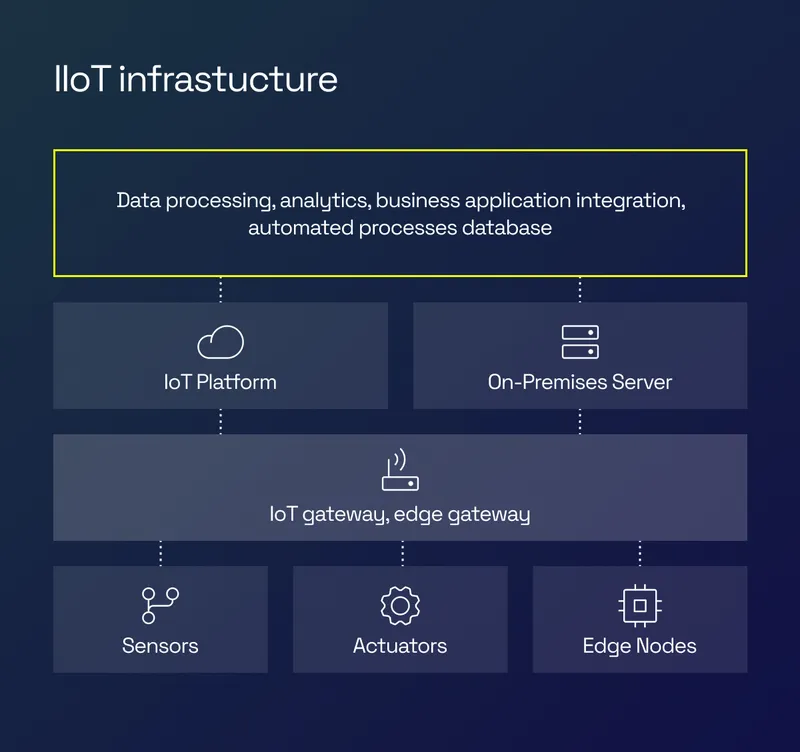
Most industrial IoT systems can be split into five layers. Data travels up from the equipment to the people who run it, and commands travel back down. The examples below come from projects we built, described in more detail in industrial IoT examples.
1. Devices and sensors
The bottom layer is the equipment itself: sensors, meters, controllers, batteries, inverters, cameras. Most of it comes from different manufacturers, and much of it was installed long before anyone planned the software. In an airport lighting management system we built, Monster, each light's controller got its own IoT module, and the system replaced the legacy software at the airport.
2. Connectivity, networking and protocols
Devices talk to the system through field protocols such as Modbus over RS-485, and send data onwards over wired networks and over Wi-Fi or cellular links. Between devices and the cloud, lightweight messaging protocols such as MQTT are common, and factories often use OPC UA, a standard for exchanging data between machines and software. On the Zeronest energy platform we built, a device reads the inverter over Modbus and sends its data to the cloud over MQTT on its own LTE link.
Cables suit fixed equipment that has to be reliable. Wireless and cellular links reach sites where cabling is impractical, and a gateway translates between field protocols and the messaging the platform expects. The control network is usually kept separate from the office network, so a problem on one side does not travel to the other.
3. Edge computing
An edge device or local controller processes data on site and makes the decisions that cannot depend on a network connection. The energy management system (EMS) we built for Skyfri decides when batteries charge and discharge and keeps exports under the grid connection limit. It keeps controlling batteries and inverters when the connection drops, and the platform reaches the sites through Azure IoT Edge and Azure IoT Hub.
4. Platform and data
A cloud or on-premises platform stores the readings, combines them with outside data and runs the analysis. Readings arrive as time series, one value per sensor per moment, so the platform stores them by time and compares them with earlier behavior. Analysis ranges from simple threshold alarms to trend models. This is also where a digital twin lives: a model of the plant fed with live data. For Kyoto Group's thermal energy storage plant we built one that adds weather data and energy price analysis and lets engineers simulate plant performance.
5. Applications for people
The top layer is what operators and engineers use: dashboards, alarms, reports and control screens, often built on SCADA (supervisory control and data acquisition), the layer that collects data from local controllers and passes operators' commands back. Different people need different alerts, so the same event can reach the control room as a short warning and the maintenance team as a task with details.
Industrial IoT vs IoT
IoT is the broader term. It covers consumer devices such as smart home sensors and wearables as well as industrial equipment. Industrial IoT is the part used in industry, where the cost of failure and the security stakes are higher. Equipment life differs too: a consumer device is replaced after a few years, while industrial machines run for decades, so IIoT software has to work with hardware installed long before it and speak the field protocols that hardware uses. And because control cannot stop when the network does, part of the logic has to run on site. On the security side, see our article on cybersecurity in IoT systems.
| Aspect | Consumer IoT | Industrial IoT |
|---|---|---|
| Equipment | New devices sold with the maker's app and cloud | Machines and controllers already installed, often from several manufacturers |
| Connectivity | Home Wi-Fi and the maker's cloud | Industrial protocols such as Modbus, wired links, cellular links and local networks |
| When the network drops | Often depends on the connection to the maker's cloud | Control has to keep working on site |
| Users | One household | Operators, technicians and managers, each with their own role, alerts and procedures |
| Cost of failure | Delay and inconvenience | Stopped production or risk to people |
| Security | Protects personal data and accounts | Protects physical equipment: a breach can reach machines |
IIoT vs Industry 4.0: what is the difference?
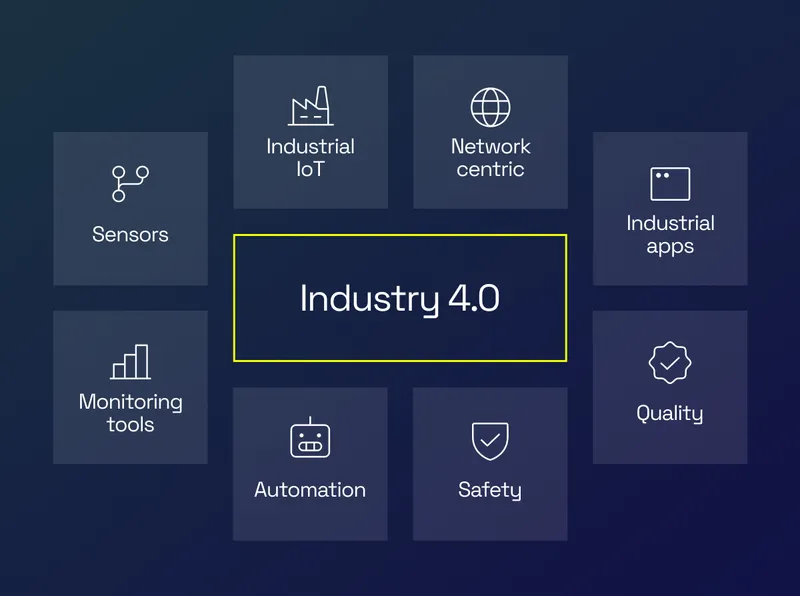
Industry 4.0 is the broader idea: the fourth industrial revolution, in which industrial operations run on automation, data analytics, cloud computing, artificial intelligence and connected equipment. Industrial IoT is one of its technologies, the part that connects physical equipment to software. A monitored pump is IIoT. It becomes Industry 4.0 when such data drives automation across the whole operation, along with planning and scheduling.
Without IIoT, the rest of Industry 4.0 has little to work with. Analytics and AI need data from machines, and automation needs a way to send commands back to them. Data from batteries and inverters feeds the decisions on when to charge and discharge, and those decisions go back to the same equipment: that loop is what the EMS in layer 3 closes.
Benefits of industrial IoT
Industrial IoT pays off where equipment is expensive to stop and hard to reach.
Real-time visibility
Operators see the state of equipment as it is, instead of finding a fault on site. Monster's dashboard, for example, shows battery levels, the state of power supplies and connectivity, and the status of UPS (uninterruptible power supply) devices. For equipment spread over many sites, one screen replaces a round of visits.
Predictive maintenance
Readings collected over time show which equipment is wearing out. A pump whose temperature creeps up or a battery that holds less charge than before stands out against its own history, so maintenance is planned for a convenient moment instead of after a breakdown.
Automation and energy optimization
Routine control decisions run in software, close to the equipment. The Skyfri EMS runs peak shaving (cutting the demand peaks a site draws from the grid) and responds to requests from the local grid operator (the DSO), with the logic running next to the batteries instead of in a remote office.
Safety in low visibility
ATOS, which we built with AP-TECH for one of Poland's main airports, combines data from induction loops and transponders into the real-time position of aircraft and airport vehicles, for operations in near-zero visibility. Controllers see those positions on a custom dashboard, so they can manage traffic and react to unusual activity.
Where industrial IoT is used
Industrial IoT is used wherever equipment is costly to stop or hard to reach:
- Manufacturing: machine and line monitoring, quality data and maintenance planning.
- Energy and utilities: batteries, inverters, storage plants and other grid-connected sites.
- Airports and transport: lighting control, the positions of aircraft and vehicles, infrastructure status.
- Logistics and supply chain: the location and condition of goods, and of vehicles and warehouses, so delays and damage show up while a shipment is still on its way.
The projects we built in these areas and what each one connects are in five industrial IoT projects.
Common challenges in industrial IoT projects
The most common challenges are integration, verification, tooling and permissions:
- Each make of equipment needs its own integration. A common protocol such as Modbus does not mean every device behaves the same way: Zeronest, a distributed energy platform, had to be integrated inverter brand by inverter brand, 16 inverter brands in total.
- Writing a setting to a device does not guarantee the device applied it, so every write needs a check. On Zeronest's platform, each configuration value was read back after writing and an alert was raised when it did not match.
- Tools for a prototype and tools for production are separate decisions. A platform that works for tests and proofs of concept still has to be checked for years of operation before production control logic runs on it.
- Roles and permissions need planning early. Who sees which alerts and who may send commands to equipment is easier to define when a project starts than to add later.
How an industrial IoT project starts
An industrial IoT project starts with a map of the equipment and continues with a feasibility check, a proof on one site and a plan for operation after launch:
- Map the equipment: the devices, their makes, the protocols they speak and what has to keep working offline. Our free discovery workshop covers it before any code is written.
- Check feasibility on the hardest part first. Before building the Skyfri EMS we ran a seven-week technical audit, because the platform had to work with hardware and site conditions the team did not control yet.
- Prove the data path end to end on one site or one type of machine before rolling it out to all of them.
- Plan for operation after launch: the engineers who know the integrations should stay with the system and keep working alongside the client's team.
Industrial IoT: frequently asked questions
What is industrial IoT (IIoT)?
Industrial IoT (IIoT) is the network of machines in industrial settings, fitted with sensors and controllers, together with the software that runs them. It collects equipment data in manufacturing and energy, at airports and in logistics, shows it to operators and sends commands back.
What is the difference between IoT and industrial IoT?
IoT is the broader term and covers consumer devices such as smart home sensors and wearables. Industrial IoT is the part of IoT used in industrial settings, where a failure can stop production or endanger people. It connects existing equipment from many manufacturers and has to keep working when the network is down.
How does industrial IoT work?
Devices and sensors on site send data over field protocols such as Modbus to an edge device or local controller, which makes local decisions. A platform stores and analyzes the data, and operators work with it through dashboards and alarms, and on SCADA screens. Commands travel the same way back down to the equipment.
What is the difference between IIoT and Industry 4.0?
Industry 4.0 is the wider shift toward automated, data-driven industry. IIoT is one of its technologies: the part that connects machines and other physical equipment to software, so analytics, AI and automation have data to work with.
What are the benefits of industrial IoT?
Industrial IoT gives a business real-time visibility of equipment, maintenance planned before failures, routine control decisions made in software near the equipment, and better safety where people cannot see.
What is predictive maintenance in industrial IoT?
Predictive maintenance means servicing equipment when its readings show wear, not on a fixed schedule or after a breakdown. It needs sensor data collected over time and a platform that compares new readings with the equipment's own history.
Where is industrial IoT used?
Industrial IoT is used in manufacturing, in energy plants and storage, at airports, and in logistics and utilities. It fits any setting where equipment is costly to stop or hard to reach.
What do you need to start an industrial IoT project?
A list of the equipment with its makes and protocols, and a decision on what must keep working without a network. A short discovery phase maps both before building starts.
Next steps
We build the software layers of industrial IoT systems, from device integration and offline control to dashboards and digital twins. More on our industrial IoT services page.
Planning an industrial IoT system? See what we build and how a project starts.
See industrial IoT services