
Energy trading platform development
Since 2020 we have built Enerace.Online, where an advisory and its clients manage energy purchases that used to live in spreadsheets. We build procurement platforms and customer order portals for advisors, for electricity and gas suppliers and for companies selling a purchasing platform as SaaS.
Tell us what you're building.
A few details tell us which engineers to bring to the first call.




Energy trading platform development for energy advisors and suppliers
Order Group builds energy trading platforms to order, of two kinds: procurement platforms where an energy buyer or its advisor manages purchasing, and portals that take a supplier's customer orders into the supplier's trading systems. Both are part of our energy software development work, and the table below shows how each differs from an ETRM.
Our longest-running project of this kind is Enerace.Online, a procurement platform for Enerace, an advisory that helps companies buy electricity and gas. The second is a purchasing portal for an electricity and gas supplier, still in development (more below).
Besides energy procurement advisors and suppliers, we build for companies that want to sell their own purchasing platform as SaaS. For background on the types of platforms, read how energy trading platforms work.

What goes into an energy trading and procurement platform
Portfolio position and budget prices
Tranche purchasing
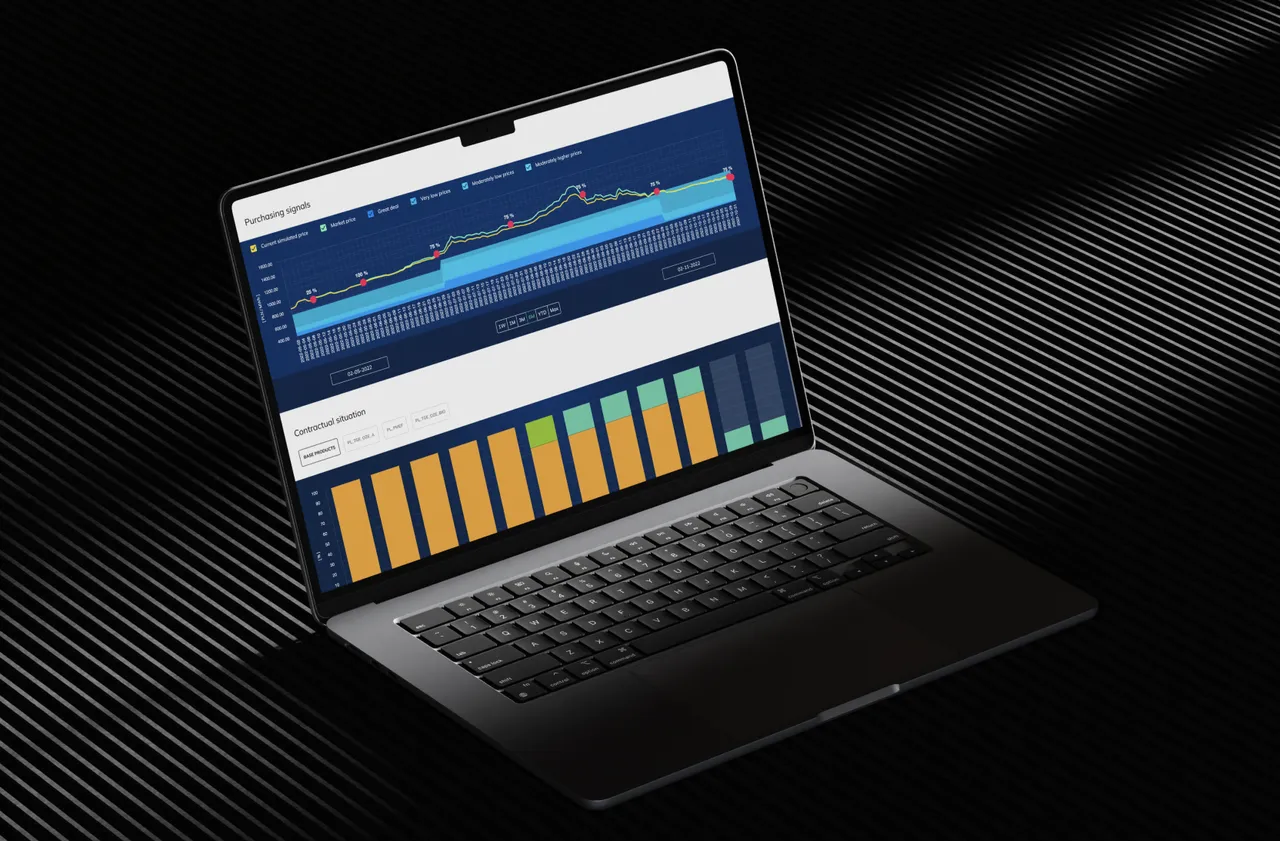
Purchase recommendations
Supplier tenders
Invoice control
Power purchase agreements
PowerShift
Electricity trading platform data: exchanges, 15-minute periods and REMIT II
An electricity trading platform needs market data updated daily, with full history. Enerace.Online takes it from ENTSO-E, the Polish Power Exchange TGE (through its API since October 2025), ICE, the Czech and Slovak market operators OTE and OKTE, and the Romanian exchange OPCOM, among others. Markets covered include Poland, the Czech Republic, Slovakia, Romania, Austria and Croatia. Besides power and gas, the data includes CO2, coal and oil prices and market indices.
Price alerts, purchase signals with risk zones, and daily and weekly reports run on that data. In 2025 the platform also started showing AI-generated market news based on it.
15-minute market periods
Since October 1, 2025 the day-ahead market coupling (SDAC) has run in 15-minute periods: 96 a day, or 92 or 100 on days when the clocks change. Enerace.Online has worked in 15-minute periods since that date. In 2026 we added import of 15-minute prices from ENTSO-E and data retrieval after the day-ahead auction results.
REMIT and REMIT II
Market participants that trade wholesale energy have to report their trades: REMIT (Regulation (EU) 1227/2011) requires reporting to ACER under Article 8. REMIT II (Regulation (EU) 2024/1106) has applied from May 7, 2024, and a new implementing regulation from April 29, 2026. In a setup with an ETRM, the ETRM stays the book of record for those trades. We have not built REMIT reporting.

Next to your ETRM: a purchasing portal for a supplier's business customers
A purchasing portal connected to an ETRM writes each trade to the ETRM once and reads trading rules from it, because the ETRM is the book of record. Companies usually buy an ETRM and build their own systems around it. We have not built an ETRM; we build the software that works next to one.
Since mid-2026 we have been building such a portal for the business customers of an electricity and gas supplier, connected to the supplier's ETRM and accounting system. After the opening workshop on July 29, 2026 and a demo on August 20, 2026, the API client for the ETRM was ready on September 17, 2026. The first-phase specification, completed the same month, describes user journeys for four roles: customer, trader, salesperson, back office. The project runs at a fixed price.
As of October 2026 the portal is still in development and does not run in production yet. What we are building:
- contracts and positions, tranches and consumption, synchronized with the ETRM,
- a catalog of instruments with prices,
- the tranche flow: the customer requests a tranche, gets an offer valid for 1 to 60 minutes and accepts it, and the trade is recorded in the ETRM. If a tranche is cancelled, it is withdrawn from the ETRM.
Enerace: an energy procurement platform built since 2020
Enerace advises companies on buying electricity and gas, and Enerace.Online is where its consultants and their clients do that work. The project started with product workshops and runs on a time and materials basis. The backend is Python with Django and GraphQL, the frontend is React, and it all runs on AWS.
Automating market data collection and recurring reports saves Enerace hundreds of hours each month, and the SaaS model has brought the company new clients. The full story is in the Enerace case study.

Energy trading software: buy, build or extend?
Whether to buy energy trading software, build it or extend what you have depends on where your advantage lies.
- Buy a ready product when you trade standard products on standard markets and the vendor's process matches yours.
- Build your own platform when the way you trade or advise clients is your advantage, or when you want to sell the software itself, as Enerace does with its SaaS platform.
- Extend what you have when your exchange or ETRM connection works, but analyses and reports are still manual, as are client tools.
A free discovery workshop, a pricing model per project, your code, an SLA
Why build with us: how a project runs
Every project starts with a free discovery workshop. Enerace runs on time and materials, the ETRM portal at a fixed price.
The code, designs and documentation we create for you belong to you by default, and after launch we stay on under an SLA.

Energy trading platform questions
Build or buy, the ETRM, market data and tranches, plus pricing and support.

-
Buy when your products and markets are standard and the vendor's process fits yours. Build when the way you trade or advise is your advantage, or when you want to sell the software, as Enerace does. Extend when the exchange or ETRM connection works but the client tools are still manual.
-
Yes. The ETRM stays the book of record: each trade is written to it once and trading rules are read from it. That is how we are building the purchasing portal for an electricity and gas supplier's business customers.
-
The ETRM keeps the book of record and risk, a trading platform concludes trades, and a procurement platform supports purchasing decisions. More in our ETRM glossary entry.
-
Yes. SDAC has used 15-minute periods since October 1, 2025. Enerace.Online has handled them from that date.
-
In Enerace.Online we integrated ENTSO-E, TGE (through its API), ICE and OPCOM, plus the Czech and Slovak operators OTE and OKTE, among others.
-
Yes. Tranches go in as MW, MWh or at an average quotation, and clients accept consultants' recommendations in the platform, with the decision kept in the history.
-
No. We build procurement platforms, customer portals and market data tools that work next to an ETRM.
-
A free discovery workshop first, then time and materials (as at Enerace) or a fixed price (as for the portal connected to an ETRM). After launch, an SLA: 15 minutes to first response on a critical incident, 30 minutes to active work, 24/7. The code belongs to you by default.
The energy procurement platform in full
Enerace case study
-
Enerace - Custom-Made SaaS Web Application for Energy Procurement Advisory
Order Group delivered astonishing work in a very organized way. They truly are a team worth trusting your project with!


Book a free consultation with an engineer
Your message goes to

Filip Szamborski
Co-founder & CEO

Your message goes to

Karol Oponowicz
Co-founder & Business Owner
Your message goes to
Paweł Zieliński
Co-founder & Business Owner
SO FAR WE HAVE WORKED WITH BRANDS LIKE:
Thank you for your message.
We read every message ourselves and get back to you within 48 hrs on business days.
Something urgent? hello@ordergroup.co