Accessibility audit services: WCAG audit and fixes in your code
Companies covered by the European Accessibility Act, public bodies and public tender contractors have to show that their web and mobile apps meet WCAG. Our team runs web accessibility audits against WCAG 2.2 AA and fixes what fails in your code. Every finding is closed after a retest.

Why work with us: accessibility audit and remediation in one team
The designers, frontend developers and QA engineers who audit your product also change its components afterwards, in React, React Native or Django. We have done this in Centrum Komunikacji and in PSONI's Generator ETR, on the web and on native mobile apps.
On iOS and Android a screen reader talks to native views, so a change often goes into a React Native component. Our glossary explains what the report of an accessibility audit contains. The entry on WCAG 2.2 explains the standard.
Daria Gusieva, Head of Design at Order Group since March 2026, leads UX, UI and WCAG accessibility on client projects. She reviews our glossary entries on WCAG 2.2, accessibility audits, screen reader testing and focus management.

What our website accessibility audit covers
All 55 success criteria, one by one
A sample agreed at the start
Automated tests
Manual and scripted tests
Screen readers on each platform
A report your team can work from
Retest and accessibility statement

Who orders a WCAG compliance audit: EAA, accessibility acts and public procurement
Four rules explain why teams order a WCAG compliance audit:
- The European Accessibility Act, Directive (EU) 2019/882, has applied since 28 June 2025 to selected digital products and services, including banking, e-commerce and e-books.
- In Poland the Act of 26 April 2024 on ensuring compliance with accessibility requirements of certain products and services by economic operators (Journal of Laws 2024, item 731) implements the directive.
- For Polish public bodies, the Act of 4 April 2019 on the digital accessibility of websites and mobile applications of public bodies (consolidated text, Journal of Laws 2023, item 1440) requires accessible websites and apps and a published accessibility statement.
- Article 100 of the Polish Public Procurement Law requires the description of the contract to include accessibility requirements for people with disabilities when people will use the system. That is how WCAG ends up in tender specifications and contracts.
This is context and not legal advice. Whether the EAA covers your service is a question for a lawyer.
Which kind of audit: WCAG version, level and platform
Public bodies usually order WCAG 2.1 AA, and the PSONI specification asks for WCAG 2.2 at level AAA. The contract or the law names the version and level, and the audit follows it.
The platform changes an audit as much as the version does. A website is tested with a web screen reader, the keyboard and zoom. A native app gets rounds with VoiceOver on iOS and TalkBack on Android, because the same screen behaves differently on each. The scope of a mobile audit is therefore the number of platforms as well as the number of screens.

Accessibility audit and remediation: changes in your code
Accessibility remediation means changing components, labels, messages and styles until each failed criterion passes. Examples from client projects:
- In the Centrum Komunikacji app, dialogs open in the fullScreen presentation style of React Native. VoiceOver stays inside the dialog and reads its 4 controls, not the 25 behind it. This is focus management.
- For PSONI we keep a sheet of all ARIA labels, the names a screen reader reads aloud, in the web and mobile apps. The same sheet works as the catalogue of error and status messages.
- The PSONI app offers 3 font sizes: 100%, 150% and 200%, which covers the 200% resize in criterion 1.4.4. Users also choose a male or female voice and the reading speed for text-to-speech.
- In PSONI, a validation message tells the user what to do when text goes over the character limit, and a button description explains what the button does. The retest passed in September 2026.
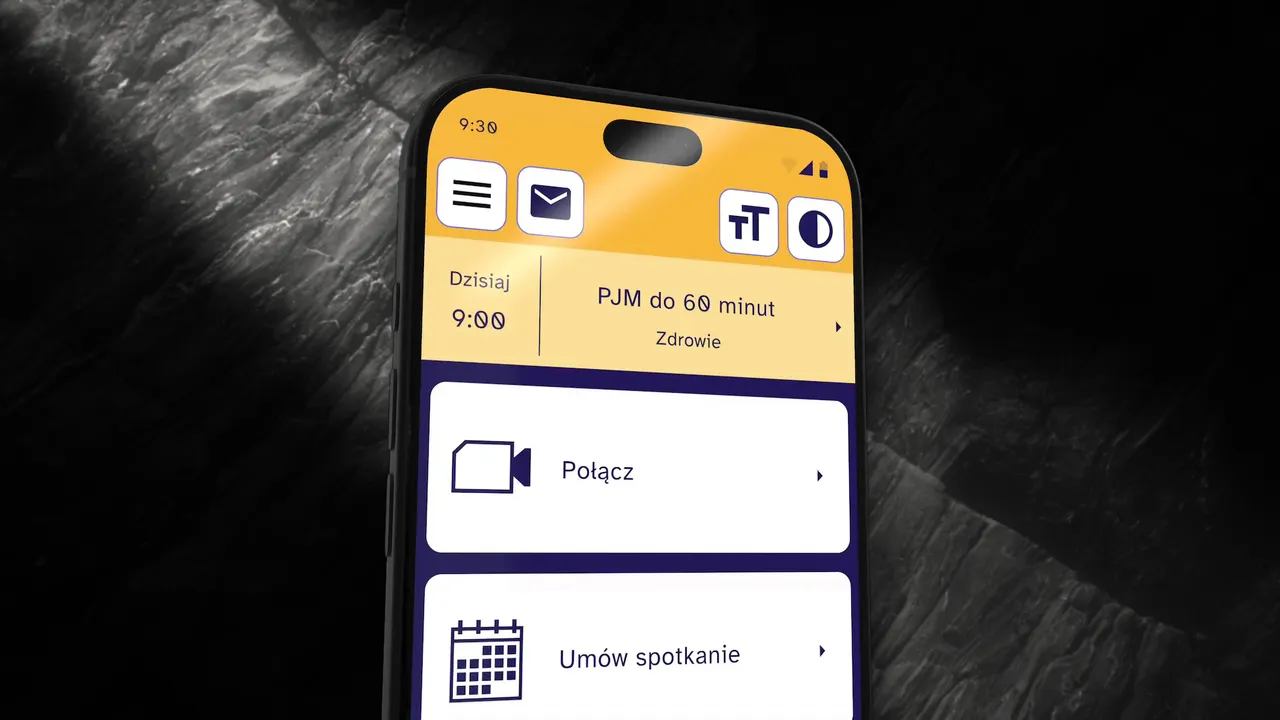
The PSONI specification requires a visible text label next to every icon, following WCAG 1.1.1 and W3C guidance for people with cognitive disabilities. A requirement like this is met in the interface design before any code is written, which is where our UX design work comes in.
Centrum Komunikacji and PSONI: screen reader rounds and retests
Centrum Komunikacji: WCAG 2.1 AA, screen readers and braille displays
Centrum Komunikacji is a mobile and web app for deaf, hard of hearing, blind and deafblind people, in production since 20 April 2026. The requirement was WCAG 2.1 AA and compatibility with screen readers and braille displays. The app was tested with screen readers throughout the project, and our team prepared the WCAG report for the stage 2 sign-off on 27 April 2026.
The rounds ran on iOS and Android, each with a retest. After the first round VoiceOver selects each tile and each icon of the bottom menu as its own element, and with a braille keyboard users type values into fields on iOS, checked on staging. The buttons in the meeting list are read by their proper names in TalkBack and VoiceOver. The next round covered the label of the button that closes a message, the reading of error messages and a list of documents with each item read by its own description, and a second VoiceOver round followed the retests.
A blind accessibility expert who works with the client tested the production app on iOS and Android. After the expert's remarks each service tile has its own label read by the screen reader, and focus on entering the order screen lands in the right place. The retest covered both platforms.
PSONI: Generator ETR and its WCAG 2.2 AAA specification
For PSONI (the Polish Association for Persons with Intellectual Disability) we build Generator ETR, a web and mobile app that turns documents into easy-to-read text.
The web screen reader round closed on 6 October 2026. The tester went through the text by sentences and by words and moved through elements with Tab, and the report became a separate task for the changes. The mobile round with TalkBack and VoiceOver followed in October 2026, and the two systems differ in details:
- On Android a single word of the text can be selected directly. On iOS the reader selects a block and moves across words with a gesture, and a double tap opens an explanation of the word.
- The progress bar of a recording works with a two-finger swipe on Android and with a double tap and a one-finger drag on iOS.
- The countdown to resending a code is read by the phone's screen reader about every 5 seconds, a rhythm the reader sets.
The exported DOCX document is checked too: language pl-PL, a title in the metadata, one H1 and proper heading styles, Arial 14 pt, 1.5 line spacing, black text on white and A4 format.

Our own website: audit, statement and result
On 10 October 2026 we audited ordergroup.co against WCAG 2.2 AA: 48 addresses in English and Polish, 55 criteria, axe-core and manual tests. The code changes from the audit went into the repository the same day, and the accessibility statement was published on 12 October. ordergroup.co meets WCAG 2.2 AA within the scope of that statement, a self-assessment under WCAG-EM, the W3C evaluation methodology.
Three items sit outside the scope of the statement:
- Video recordings in the Video section, where captions and transcripts are in preparation.
- PDF e-books, which are not fully tagged. On request we send the content in an accessible form.
- Third-party content: the Cookiebot banner and the YouTube player.
The site has an accessibility panel in the header with larger text, high contrast, paused animations and video, underlined links and larger text spacing. It works fully from the keyboard, has a skip-to-content link and a visible focus, respects the system setting for reduced motion, and fits down to 320 px and 200% zoom without horizontal scrolling. Barriers can be reported at the address in the statement, and we reply within 5 working days.
The three checks behind the audit and their results after the code changes:
What buyers ask before ordering a WCAG audit
Questions about WCAG audits

-
A web accessibility audit checks an agreed sample of screens and processes against every WCAG 2.2 A and AA criterion. It combines automated tests, manual and scripted tests and screen reader rounds on each platform, and ends with a report and a retest of each finding.
-
An automated scan is not enough for a WCAG audit. It checks only part of the criteria, and some can only be judged by a person, so our manual and scripted tests cover the rest.
-
Yes, the team that runs the audit also makes the changes. Designers and developers change the design and the code in React, React Native and Django, and the finding stays open until the retest passes.
-
We test with VoiceOver on iOS and TalkBack on Android and compare the same flows. Selecting a word and moving a progress bar work differently on the two systems, so each flow is checked on both.
-
The sample of screens and processes, the WCAG version and level, and the number of platforms set the scope. Each platform tested with a screen reader is a separate round, so we agree the scope before the audit starts.
-
The report shows the state of every criterion. Full compliance also depends on content such as captions for videos, which the content owner prepares, so you know what remains and who owns it.
-
An audit should use the version and level that your contract or the law names. Our default is WCAG 2.2 AA, and a public body may require WCAG 2.1 AA.
-
A table of the 55 WCAG 2.2 A and AA criteria with a status for each, and a list of issues. Every issue has the criterion, the place, steps to reproduce, the expected result and a priority, so it can go straight into your backlog.
-
The Act covers selected digital products and services, including banking, e-commerce and e-books, and a lawyer should assess whether yours is one. Our part is to check the product against WCAG and change what does not pass.
-
A finding is closed after a new test of the change, on every platform in scope. A commit alone does not close it. The retests also give you material for your accessibility statement.
Built to WCAG 2.1 AA, tested with screen readers
Accessibility in a live project

Tell us what you need audited
Your message goes to

Filip Szamborski
Co-founder & CEO

Your message goes to

Karol Oponowicz
Co-founder & Business Owner
Your message goes to

Paweł Zieliński
Co-founder & Business Owner
SO FAR WE HAVE WORKED WITH BRANDS LIKE:





Thank you for your message.
We read every message ourselves and get back to you within 48 hrs on business days.
Something urgent? hello@ordergroup.co