
Virtual power plant software for aggregators and energy cooperatives
An aggregator is paid for power delivered on time, so our DSR module for Zeronest reports each call hour 15 minutes after it ends. We build VPP layers: DSR in production for Zeronest, cooperative settlement built for it in 2026, and battery market orchestration in development for Global Green.
Tell us what your portfolio needs.
Send us your asset list and the markets you bid into, and we will bring the right engineers to the first call.




Virtual power plant software, built layer by layer
Virtual power plant software is the portfolio and market layer that turns many metering points, batteries and solar sites into one resource an aggregator can sell. We do not offer a ready-made VPP platform, and we have not built one end to end. We build its layers, as part of our energy software development work.
Aggregation and demand response calls run in production in the module we built for Zeronest. Orchestration of setpoints on a battery site is the layer we are building for Global Green, and it is not yet in production. Control of a single site or battery belongs to the energy management system, and buying and selling energy to an energy trading platform.
If you run an aggregator, a VPP, an energy cooperative or batteries that provide balancing services, these are the layers you will need around your sites.

Demand response software: from a call to a settled hour
Demand response software takes an aggregator's call, splits it across metering points, tells participants and settles the hour against a baseline. We have been building the demand-side response (DSR) module of the Zeronest platform since May 2025, and on March 23, 2026 it handled a real call in production.
The module has a DSR operator, who sees all installations, and a DSR client, who sees only its own. A separate consultant role acts on behalf of the aggregator or a client. The module groups metering points into aggregation units and stores unavailability notices for each point and each unit. The aggregator creates a call that covers many of its clients' metering points.
Since 2026 each metering point receives its own declared power in a call instead of an equal share, with a buffer above the ordered value. For example, a 5 MW call can require 5.25 MW from clients. The API rejects a call whose total does not match the limit and the buffer, and it splits power into whole kW. A call lasts at most one hour and starts on the full hour, and calls are expected between 7:00 and 22:00.
The baseline is corrected with data from the third, fourth and fifth hour before the call. The correction factor is the average difference between consumption and the profile, capped between -20% and +20%, and it also applies to the following hours of the call. When meter data goes missing after an outage, the platform has a process for restoring it, including gaps longer than 10 days.
Participants receive an SMS and an e-mail with a confirmation link. Ten minutes after a call is created, the system checks SMS delivery and e-mails the operator a list of messages that were not sent. The report for a call hour is ready a quarter of an hour after it ends, so a 14:00-15:00 call is reported at 15:15. The call limit in the report is the sum of the metering points' limits. A client whose points share a call with others sees only the combined power of its own points.

Energy cooperatives: hourly settlement for members
Energy cooperative software calculates, hour by hour, what each member and the cooperative as a whole owe and are owed. We built the energy cooperative module for Zeronest in 2026. It settles a cooperative on two levels, the whole group and each metering point. It divides the energy of every hour into three streams: used by members on site, put into the deposit, and exchanged with the grid. The deposit is unused energy carried over to later months.
Hourly settlements are available through an API. They are recalculated every 5 minutes between the 23rd and 58th minute of the hour, with a check of who was a member in that hour. In July 2026 the cooperative operator got control over many installations at once, and in September 2026 a new deposit settlement mode. Testing caught, among other things, Wh shown as kWh and group self-consumption calculated from the wrong measure.
The rules come from Polish law. A cooperative can have up to 10 MW of capacity and must cover at least 70% of its own needs. Energy the members feed into the grid is set against energy they take from it at a 1:0.6 ratio, on hourly data, and the deposit is valid for up to 12 months. From October 19, 2026 the hourly data comes from CSIRE, Poland's central energy market information system.

Balancing markets and grid operator commands
Balancing market software has to deliver declared power within the market's activation time while respecting the limits set by the distribution system operator (DSO). PSE, the Polish transmission system operator, gives full activation times for its four balancing products: 30 seconds for FCR, 5 minutes for aFRR, 12.5 minutes for mFRR and 30 minutes for RR.
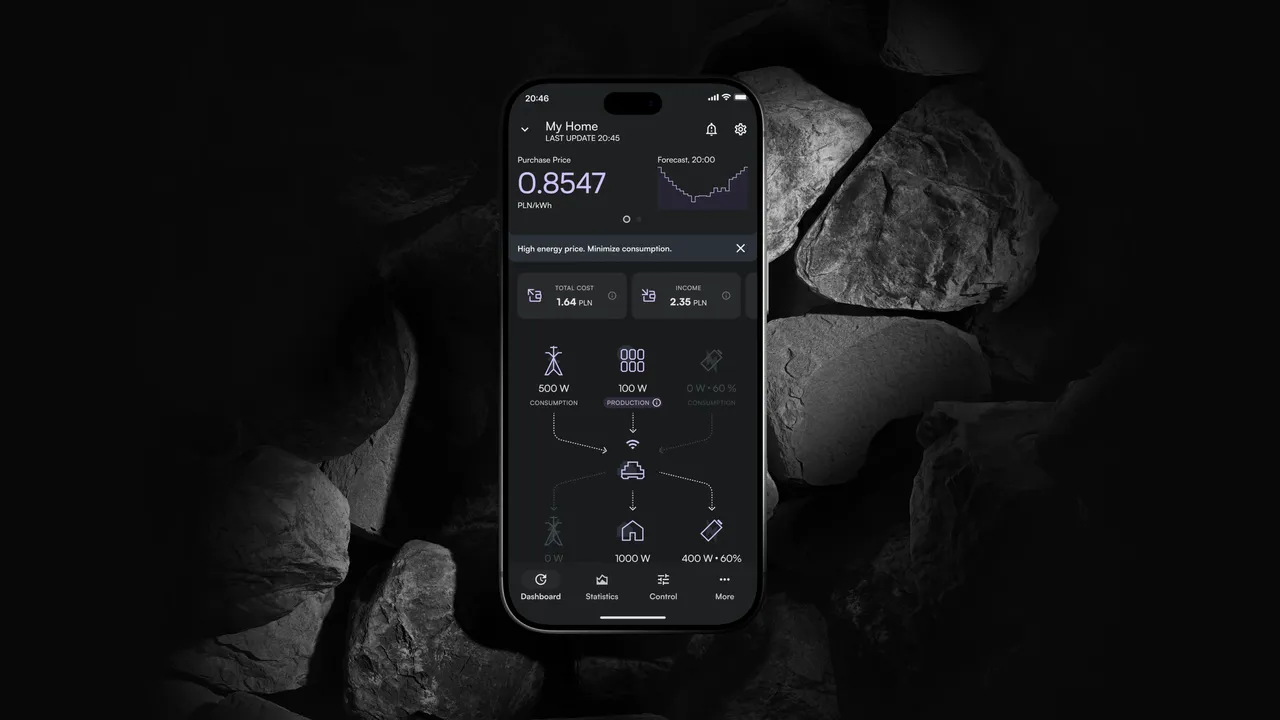
Since December 2025 we have been building an EMS for Global Green, an operator of solar and battery storage sites in Germany and Canada, covering 15 MWh of storage. The EMS runs on an industrial computer on site and sends data to the cloud. Its orchestrator combines setpoints from trading, aFRR and direct control, resolves conflicts between them and only then splits the result across batteries. We closed the orchestrator's initial implementation on June 29, 2026, and the MVP is in progress.
Two additions came in July 2026. The first is loss compensation: after resolving conflicts, the orchestrator raises discharge power and lowers charge power by a configured percentage, so the commitment is met at the grid connection point. The result never leaves the battery's operating range, and every clipped value is logged. The second is three controllers for DSO commands: a battery limit, a direct battery command and an export limit. We modelled the DSO in a simulator. In September 2026 a new version of the EMS went onto the controller at one site.
As of October 2026, migration of the existing aFRR pipeline to the new platform is in testing, and the controller that combines trading and aFRR on one battery has a finished design and is being implemented.
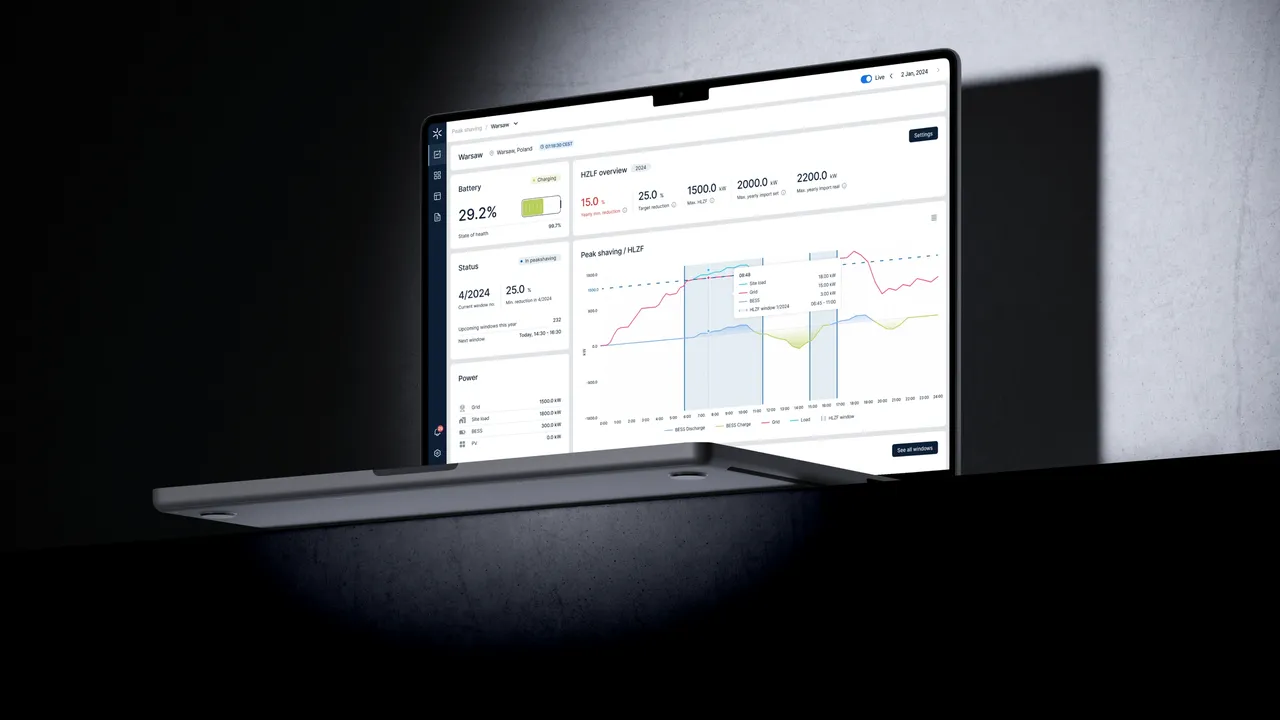
The EMS we built for Skyfri does peak shaving and limits export at the DSO's request. By October 2024, DSO-requested export limiting, zero-export algorithms and a maximum load limiter had been tested on site together with the DSO.
Building for the Polish market
Polish flexibility rules changed in 2024 and 2025, and VPP software has to follow them. The second reform of the Polish balancing market took effect on June 14, 2024. It moved balancing market settlement to 15-minute periods and lowered the minimum unit size from 1 MW to 0.2 MW. The DSR calls in our Zeronest module last up to an hour and are reported by the hour. PSE joined the European PICASSO platform for aFRR on July 11, 2025.
An aggregated scheduling unit (JGA) can range from 0.2 to 50 MW. According to URE, the Polish energy regulator, no aggregator unit had been registered by June 30, 2025. In the capacity market's DSR, PSE announces call periods at least 8 hours in advance, and a failed test costs the capacity payment and a penalty.
Market rules we have already coded, and one team after launch
Why aggregators build with us
Our DSR module for Zeronest handled a real call in production on March 23, 2026, with a baseline, a buffer and an hourly report.
After launch, the same engineers support you under a 24/7 SLA.
How a project runs
Contact
Free discovery workshop
Build
Support
The energy systems behind these layers
Case studies
Questions about VPP and demand response software
Platform scope, DSR calls, cooperatives, balancing and the Polish market.

-
No. We build its layers. The aggregation and demand response layer we built for Zeronest runs in production. The orchestration layer for a battery site, which we are building for Global Green, is still in development.
-
In the Zeronest module each metering point gets its own declared power, with a buffer above the ordered value, so a 5 MW call can require 5.25 MW from clients. Power is split into whole kW, and the API rejects a call whose total does not match the limit and the buffer.
-
The baseline is corrected by a factor from the third, fourth and fifth hour before the call: the average difference between consumption and the profile, capped between -20% and +20%. After an outage the platform restores missing data, including gaps longer than 10 days.
-
They get an SMS and an e-mail with a confirmation link. Ten minutes after the call is created the system checks SMS delivery and tells the DSR operator which messages did not go out. The report for the call hour is ready 15 minutes after the hour ends.
-
Not yet in production. That is what the orchestrator we are building for Global Green is for. It resolves conflicts between trading, aFRR and direct control setpoints, and loss compensation makes sure the commitment is met at the grid connection point. The controller that combines trading and aFRR on one battery is being implemented.
-
In the Global Green EMS, DSO commands have separate controllers for the battery limit, the direct battery command and the export limit. The EMS we built for Skyfri limits export at the DSO's request, and by October 2024 this had been tested on site together with the DSO.
-
Hourly settlement on two levels, the cooperative and each metering point, with energy split into three streams: used on site, put into the deposit and exchanged with the grid. Our module recalculates every 5 minutes and handles the deposit. From October 19, 2026 hourly data in Poland comes from CSIRE.
-
Since the reform of June 14, 2024, units from 0.2 MW, down from 1 MW. An aggregated scheduling unit (JGA) can range from 0.2 to 50 MW.

Book a free consultation with an engineer
Your message goes to

Filip Szamborski
Co-founder & CEO

Your message goes to

Karol Oponowicz
Co-founder & Business Owner
Your message goes to
Paweł Zieliński
Co-founder & Business Owner
SO FAR WE HAVE WORKED WITH BRANDS LIKE:
Thank you for your message.
We read every message ourselves and get back to you within 48 hrs on business days.
Something urgent? hello@ordergroup.co