AI software development company: private LLMs and AI in your product

We are an AI software development company that builds language-model features into web and mobile products. For PSONI we host an open model on rented GPU servers, and for Centrum Komunikacji we added live speech-to-text to a Polish Sign Language platform.

Free AI discovery workshop

Tell us what you're building.

A few details let us bring the right engineers to the first call.

  • Software projects

    160+

    across all industries

  • Team

    40+

    full-time

  • App users

    40,000+

    across all our projects

Where the model runs and who checks it

Texts that people paste into an app can be personal, which is why PSONI could not send them to a public AI API. Automatic captions confuse names, addresses and medicine names, which is why Centrum Komunikacji has a person correct them. Situations like these decide how an AI feature is built: where the model runs, who checks its output and what surrounds it.

Enerace

What AI automates in the products we build

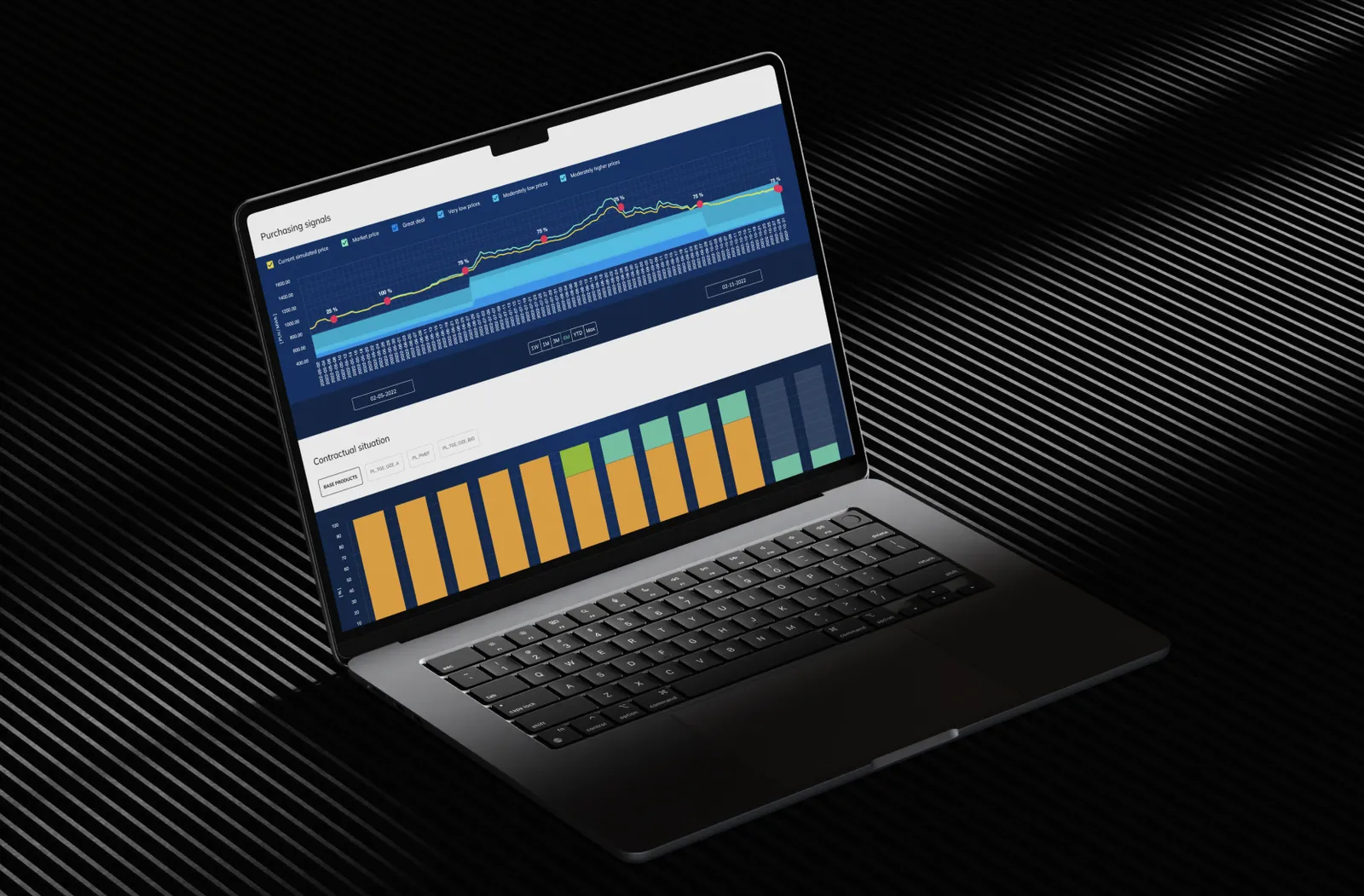
AI takes over repeatable reading and writing around a product, and people keep the decisions. Enerace.Online, an advisory platform for industrial buyers of energy and gas that we have built and developed since 2020, has shown an AI summary under each market news item since 2025. The feature arrived without rewriting a platform of more than 20 functional areas.

Enrace
  1. Summary

    Each news item pinned to a price chart gets a short summary in English and in Polish, written when the item is added.

  2. Commodity and place

    The model assigns one of 9 commodity types and one of 38 countries or regions.

  3. Market direction

    A rating of rise, fall or unchanged with a short justification. It is the model's assessment, and a person confirms it.

  4. Text and background task

    A crawler fetches the text, with a browser as a fallback. An editor pastes it in when that fails, and Celery runs generation.

How a project runs

AI software development services: from discovery to run

An AI software development project runs in five steps: discovery, proof of concept, MVP, launch and support, each answering one question. In discovery we also size the model and the GPU servers against the expected traffic, and sometimes the outcome is advice to skip the language model altogether.

  1. Discovery

    One free meeting that ends in a scope, an estimate and a success test. We check the product, the data, the rules and the task. Our own AI toolkit supports the session.

    Free

  2. Proof of concept

    Can a model do this task well enough on your data? Test samples and a quality measure come before the first prompt. PSONI began here, with a first prompt and a readability script.

    One question

  3. MVP

    The backend, accounts and web and mobile apps around the model, with the proof-of-concept measures still running. Generator ETR for PSONI is in stage V of eight.

    Real users

  4. Launch

    A production feature that you can watch work, checked by the measures agreed earlier. AI summaries on Enerace have been live since 2025.

    Live

  5. Support

    Maintenance while models, prompts and data change, so the feature keeps working as intended. The renovation platform has been our client since May 2022.

    Ongoing

Language models that stay on your servers

A private LLM is a language model that runs on servers you or your hosting provider control, so the texts it reads never pass through a public AI API. The same setup of an open model, vLLM and an application around them can run on your servers if they have suitable GPUs, or with a cloud provider in the region your rules require. Our page on on-premise LLM deployment covers the options, and the glossary explains how self-hosted LLMs differ from API models.

PSONI, the Polish Association for Persons with Intellectual Disability, chose this route for Generator ETR. The texts people paste in can be personal, so a public API was ruled out. A proof of concept compared PLLuM 12B, a Polish language model, with the 26B mixture-of-experts version of Gemma 4 on one text-simplification task, and Gemma 4 gave better results on the project's data. We serve it with vLLM on GPU servers we rent, so no text goes to an AI provider's API.

Deployment scripts start a GPU instance, install vLLM with the Gemma 4 weights and expose an API compatible with the OpenAI specification. Since September 2026, ahead of PSONI's acceptance tests, the staging environment has run on fixed GPU capacity, so the model stays available if the provider reclaims a rented instance.

What Gemma 4 26B A4B needs in GPU memory

The model activates about 4 billion parameters per token, yet all 26 billion have to sit in GPU memory. These are the figures from Google's documentation, and we size GPU servers against figures like them.

26 B

parameters that sit in GPU memory, although about 4 billion are active per token

57.7 GB

in 16-bit precision, before the cache for active conversations

14.4 GB

in 4-bit quantization, which stores the weights at lower numeric precision

Private LLM or public AI API

Private LLM and public AI API compared
QuestionPublic AI APIPrivate LLM
Where does the data go?Every prompt and document leaves your infrastructure for the provider's serversTexts stay on servers that you or your hosting provider control
Which model version do you run?The provider retires old versions on its own scheduleThe open model version you tested stays for as long as you need it
What do you size?Nothing on your side, because the provider runs the capacityGPU capacity from the number of concurrent requests and a load test on realistic documents
What quality can you expect?The largest models are stronger at general tasksBest on a narrow task with its own evaluation
What keeps it running?The providerA pinned model version, a health check with automatic restart, timeouts, a maximum input size, a queue limit and the recorded licence of the weights
Who looks after it?The providerYou, or us under support and maintenance

AI agents and chatbots

An AI agent is a language model that can call tools, such as a search over product data, and carry a conversation toward a result. A chatbot answers, and an agent also acts through the tools it is given.

One of our long-term clients, who stays anonymous, runs a product platform for the home renovation and interior fitting market, and we have worked with it since May 2022. The system manages renovations and property finishing: ordering products, an AI-supported search engine, managing work and communication with workers. It is built in Python, Django and Django REST Framework, and the in-app AI chat and the product-search agent are in production today.

The agent searches the texts and metadata of many products at once, across the offers of many suppliers. Part of the work moved from the model to Python code for repeatability: the code builds the search query, so the same question always gets the same answer, and the model holds the conversation. When a search finds nothing, the agent repeats it with changed parameters.

For a price question the agent fetches the price, and the answer carries the source address of the product. Each message to the AI carries the customer's context, name and phone number, so the conversation can move on to customer service. Our page on AI agent development explains how we design agents, and the glossary entry on MCP defines the protocol agents use to reach a system.

Integration

AI integration into an existing product

AI integration means adding a model-driven feature to a product that already works, without rebuilding it. The backend calls a separate AI service, which reaches a model and can expose its work to other systems and to agents.

  1. Product

    • Web and mobile apps Where users meet the AI feature.
    • Backend service layer Calls the AI service, so the AI part can be measured, changed or switched off alone.
  2. AI service

    • Separate AI service Runs the feature on its own. On the renovation platform a flag, ai_enabled, switches it on or off.
    • Quality checks The measures agreed for the proof of concept keep running after launch.
  3. Model

    • Provider API A faster start. It fits when the data may leave your infrastructure.
    • Model we host An open model served by vLLM. It fits when the data may not go to a provider.
  4. Other systems

    • API for other systems Several products or teams call one AI capability through an interface.
    • MCP server AI agents call the product's functions with controlled access, as on our own MCP server.

Highlighted: the hosted model

Which route fits depends on where the data may go: a provider's API or a model we host. Whether other products or agents need the capability decides the rest. We settle both in discovery.

AI for accessibility: live speech-to-text for deaf and hard of hearing users

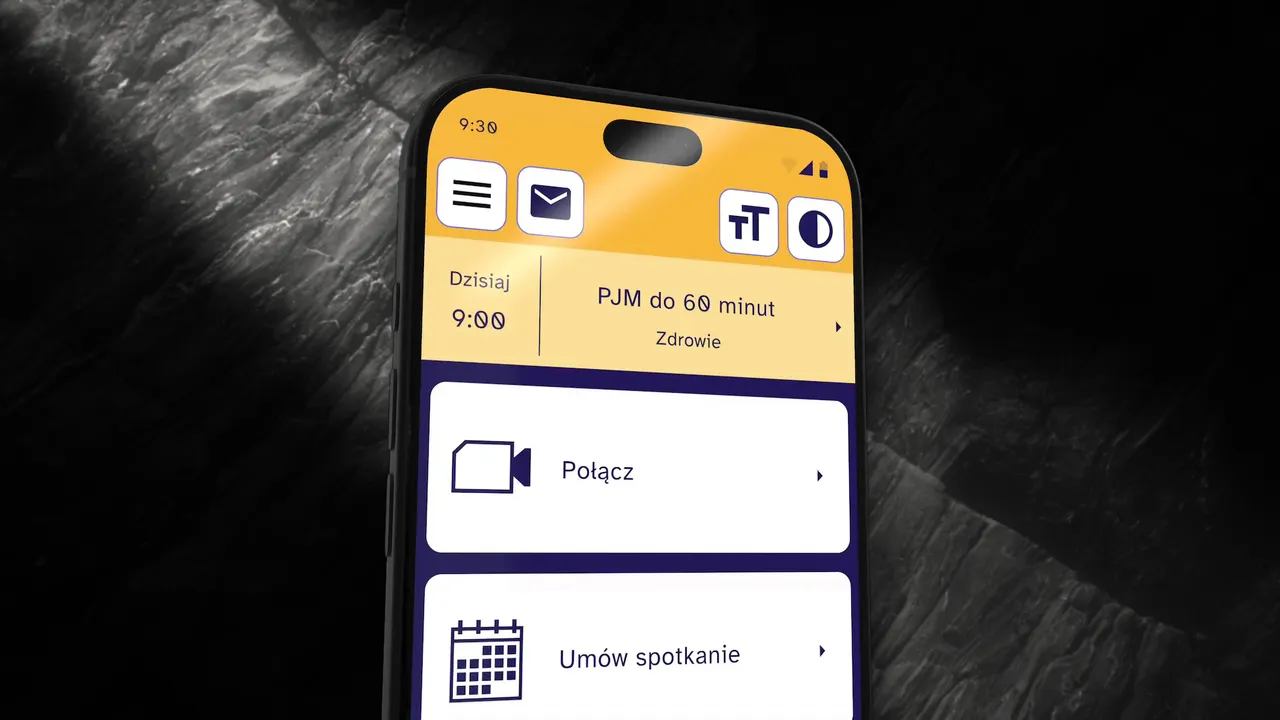
AI for accessibility, also called accessibility AI, makes content usable for people who cannot use it as it is, for example by turning speech into text. Centrum Komunikacji does it live in production for deaf and hard of hearing users. The Polish Association of the Deaf runs this Polish Sign Language (PJM) interpreting platform, financed from the European Funds for Social Development 2021-2027. The web and mobile app serves deaf, deafblind and blind people with audio and video calls, chat, history and queueing.

Workshops with the client took place in July 2025, and the platform went into production on 20 April 2026, nine months later. Live speech-to-text for hard of hearing and late-deafened users is one of the features we added. A session lasts up to 30 minutes and is available at once, within the limits of the specialist's availability. The full story is in the Centrum Komunikacji case study.

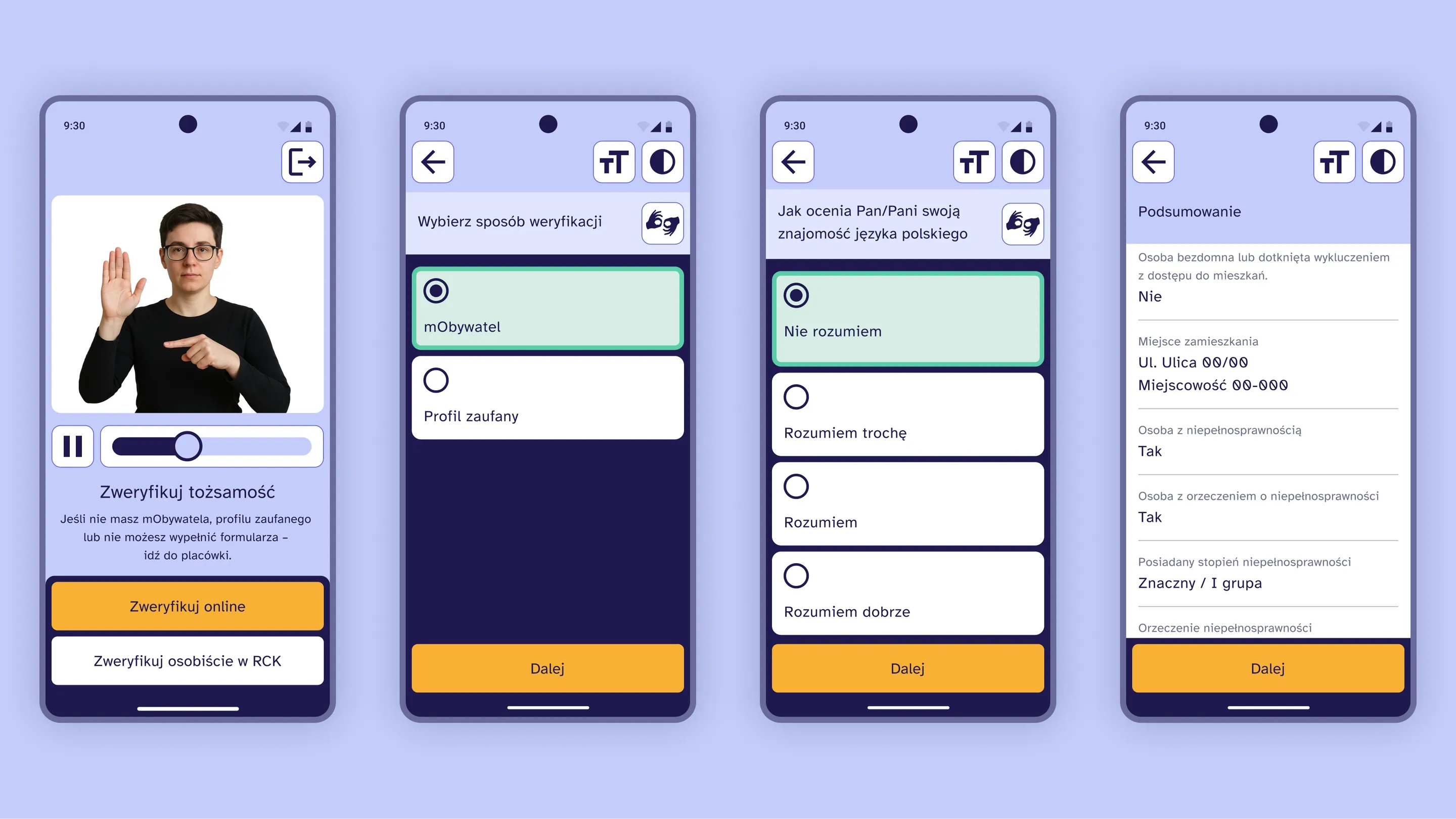
Four mobile screens: a sign language video guide to identity verification, choosing mObywatel or Trusted Profile, rating Polish language skills, and a summary of disability details.

Automatic captions confuse names, addresses and medicine names, so a person corrects them

The path of one sentence:

  • Vosk with a Polish model writes a first draft in the specialist's browser
  • A transcription specialist corrects the draft during the conversation
  • Only the corrected text reaches the user as a chat message
  • Draft and approved text have different colours in the interface
  • The client, the specialist and the person on the phone each get a separate stream
  • A hard-of-hearing person can also call, and a specialist transcribes the other side

Accessibility AI for readers with intellectual disabilities

Generator ETR is a web and mobile app for PSONI that turns difficult text, such as an official letter, into easy-to-read language (ETR is the abbreviation used in Poland). The contract was signed on 26 February 2026 for 24 months, until February 2028, and is split into eight stages.

The phone reads text from a photo of a letter on the device with Google ML Kit and Apple Vision, and PDF documents go through a separate pipeline on the server. A glossary explains difficult words in the context of the sentence, text-to-speech reads the result aloud and highlights the fragment being read, a "simplify more" option produces one further level, and a history keeps past simplifications and exports them to DOCX. Before speech, a normalisation step expands abbreviations, dates and numbers and makes Polish numerals agree with the nouns they count.

The specification requires WCAG 2.2 at level AAA, and later stages include accessibility checks with screen readers and in the DOCX files the app generates. Accessibility also has a legal side. The European Accessibility Act (Directive (EU) 2019/882) has applied since 28 June 2025 to, among others, consumer banking services, and in Poland the act of 26 April 2024 on ensuring compliance with accessibility requirements applies.

How we check that AI output is good enough

A metric, a person, jailbreak tests or a backtest, depending on the project
ProjectHow we checkWho checks
PSONI, quality of simplificationA Python script scores each output with the Gunning Fog index, which estimates how many years of schooling a text demands. It was designed for English, so on Polish text it shows a trend between versions. The first evaluation pipeline, with a system prompt and an aggregated report on synthetic samples, was delivered in June 2026A reviewer trained in the ETR standard rates real outputs against their sources, and editors check the collection of texts behind the samples in a separate online service
PSONI, each iterationEach iteration has defined goals, such as expanding abbreviations and replacing words that are too difficult. Jailbreak tests repeat with it: they try to pull the model away from its job, for example by asking for an apple pie recipe instead of a simplified letterQA
PSONI, reading aloud and legal textsNormalisation for speech is checked against a fixed sample text with numerals, ordinal numbers, decades, Roman numerals, ranges and negative numbers. For legal and medical texts the app shows a notice that the simplified version is not a legal document and that a lawyer or doctor can explain the detailsA fixed sample text, and the notice in the app
EneraceEach summary has a status: new, in progress, generated or confirmed; only confirmed summaries reach the reports and the news list in the appAn editor
Centrum KomunikacjiThe user sees only corrected textA transcription specialist
Renovation platformRounds of analysis on real conversationsOur team
Sales forecastsA model gate and a backtest on sales that have already ended for every recommendationThe model gate in the pipeline
Our MCP serverServer-side response codes block a page without a brief and publishing with audit errorsThe server, and a person approves each brief

When a project needs no language model

A project needs no language model when statistical models solve the task, as in our sales forecasting system for a live events company. The client is another anonymous company from that market, and the models are trained and validated on its ticket sales data. The project began in September 2026 with a short technical study of the data sources. Ticket sales come from the client's events service, a ticketing platform, an international events aggregator and the client's spreadsheet, and feed a data warehouse built with dlt and dbt on ClickHouse and orchestrated in Dagster.

A model forecasts the final sales of an event from comparable, finished sales curves, with an empirical interval, and gives no forecast when it has fewer than five comparable curves. It also calculates sales pace against the median of comparable events, the risk of selling out and anomalies in the basket, and the analysis covers the effect of weather on attendance and sales.

Training and validation closed on 20 October 2026, and the results reach a portal with an event list, a sales plan and a "how it is going" rating, with user accounts and roles.

Whether a task needs a language model is a discovery question. Our page on AI proof of concept and MVP and the article on AI proof of concept development show how we test it before the whole app is built.

Technologies we use

A model layer runs next to ordinary application software. Each entry names the tools in one layer and the project where they run.

  1. Models and serving

    Gemma 4 26B A4B served by vLLM, with PLLuM 12B tested as the alternative, on PSONI. Bash scripts and Docker start GPU instances repeatably. vLLM keeps the attention key-value cache in fixed-size blocks (PagedAttention) and exposes an OpenAI-compatible HTTP API, so code written for a hosted API can point at a self-hosted model by changing the base URL and the model name.

  2. Accessibility features

    Google ML Kit and Apple Vision read text from photos on the device, a separate pipeline handles PDF files on the server and speech synthesis highlights the fragment being read. All of it runs in PSONI.

  3. Data protection

    Microsoft Presidio anonymises texts. In Generator ETR sensitive data is encrypted with Fernet, files sit in a private bucket with encryption at rest, and content has a default retention of 30 days. On Centrum Komunikacji personal fields are encrypted with a symmetric key, and a user's data can be deleted irreversibly on request, with a log of who did it, when and on what basis.

  4. Applications and backend

    Django, Django REST Framework and Celery serve the API and run background tasks, and React and React Native build the web and mobile apps, on PSONI. Enerace adds a GraphQL API, TypeScript and AWS.

  5. Data and forecasting

    dlt and dbt on ClickHouse load and model ticket data, Dagster orchestrates it, and PostgreSQL and Next.js serve the portal, with Traefik at the edge. The code lives in a monorepo with Docker and CI. This is the sales forecasting project.

  6. Real-time communication

    Centrum Komunikacji runs on Django, React and React Native (Expo), self-hosted LiveKit with end-to-end encryption and LiveKit SIP for calls, a PostgreSQL cluster with failover, Redis Sentinel and S3. The key components are open source, and hosting and data stay in the EU.

  7. MCP server

    Our production server, live since 9 July 2026, had 164 tools on 20 October 2026, from pages and SEO to media, redirects, analytics and leads. It uses the official MCP SDK for Python (FastMCP), with stdio locally and streamable HTTP in production, as a thin layer over the CMS REST API, so validation and permissions live in the API. Docker without root privileges, a /healthz health check, nginx with TLS, Swagger UI and an OpenAPI schema.

  8. Public MCP endpoint

    The endpoint at ordergroup.co/mcp is stateless: each call is one POST with a JSON-RPC message, answered with JSON and no session. It has been open without a token since 8 October 2026 and is listed in the official MCP registry as co.ordergroup/public.

  9. A proof-of-concept workflow

    The frontend comes first, with an interactive preview built in v0.dev (React, Shadcn UI and Tailwind CSS). Cursor IDE then generates the backend endpoints that support it, for example Django views and serializers or FastAPI.

Glossary

AI terms explained

The concepts behind this page, each with its own entry.

  • LLM evaluation

    LLM evaluation is the systematic testing of a language model's outputs on a fixed set of inputs against agreed acceptance criteria, using automatic checks, model-based grading and human review. It decides whether a model, prompt or version is good enough to ship.

  • Self-hosted LLM

    A self-hosted LLM is a large language model whose weights run on infrastructure you control, your own servers or rented GPUs. Prompts and outputs never reach a model vendor.

  • MCP (Model Context Protocol)

    Model Context Protocol

    The Model Context Protocol (MCP) is an open standard that connects AI applications to external data sources and tools. An MCP server publishes a list of tools, each with a name, a description and an input schema, and the AI client asks what is available and lets the model choose.

  • Easy-to-read (ETR)

    Easy-to-read

    Easy-to-read (ETR) is a way of writing information so that people with intellectual disabilities can understand it, with everyday words, short sentences and one idea per line, checked by readers from that group. Inclusion Europe publishes the European standard.

  • WCAG 2.2

    Web Content Accessibility Guidelines 2.2

    WCAG 2.2 is the W3C standard for accessible web content. It sets 86 testable success criteria at three levels, A, AA and AAA. Content that meets WCAG 2.2 also meets 2.1, the version that EU and Polish rules for websites and apps point to at level AA.

  • EU AI Act

    Artificial Intelligence Act, Regulation (EU) 2024/1689

    The EU AI Act, Regulation (EU) 2024/1689, is the EU law that sorts AI systems by risk. It bans some practices, sets requirements for high-risk systems such as credit scoring of individuals, adds transparency duties and regulates general-purpose AI models.

  • Data anonymization

    Data anonymization is processing personal data so that no one can identify the person by any means reasonably likely to be used. Anonymous data falls outside the GDPR; pseudonymized data, which can be re-linked with separately kept information, remains personal data under the GDPR.

  • European Accessibility Act (EAA)

    European Accessibility Act, Directive (EU) 2019/882

    The European Accessibility Act (EAA), Directive (EU) 2019/882, is an EU law that requires selected products and consumer services, such as e-commerce, consumer banking, e-books and passenger transport apps, to be accessible to people with disabilities. It has applied since June 28, 2025.

  • Screen reader testing

    Screen reader testing (VoiceOver, TalkBack, NVDA)

    Screen reader testing checks an app or website with VoiceOver, TalkBack, NVDA or another reader that blind and low-vision people use to hear the interface. A tester goes through every screen and checks what is announced, in what order, and whether every task can be finished.

How an AI project with us starts and who owns the code

An AI project starts with a free discovery workshop, runs in two-week sprints and ends with code that belongs to you. The team that runs the discovery builds the product afterwards, so scope and decisions are not handed over a second time. The workshop needs your Product Owner or the decision maker who confirms the scope, and our Project Tech Leader and Business Owner take part, with a Product Designer when the project has a UX or UI layer.

PSONI's Discovery phase ran from 17 March to 15 June 2026, with Discovery sprints and sprints on an AI proof of concept, and it ended with a demo and the stage's acceptance documentation. An extended discovery, a separate and wider scope, produces a written summary, the confirmed scope, maps of user journeys and user flows, mockups or a clickable prototype, a backlog and user stories.

A project then starts with a kick-off with the client. We agree the methodology, set up YouTrack and the communication channels and assign the roles of Project Tech Leader, Product Owner and, optionally, Scrum Master. Work runs in two-week Agile sprints that each end with a working demo.

An MCP server project ends with the source code, automated tests of the API, API documentation as an OpenAPI schema, a Docker image ready to deploy and the call log, as described on our page about MCP server development. Copyright to the code passes to you with each payment, within the fields of exploitation named in the contract, and PSONI owns the code of Generator ETR. After launch we stay on for support and maintenance, because models, prompts and data keep changing.


How to choose an AI development company

A good AI development company answers these questions with named projects and facts. Our own answers are in the sections above.

  • Which projects can they name?

    Look for named projects with a model and real data, and for the person who checks the output.

  • How do they choose the model?

    Look for a test on the real task, with the candidates and the data named.

  • Where does the model run?

    Look for a clear place for the model, and for what happens to the data stored around it.

  • Who owns the result?

    Look for the source code and for the rights to the code passing to you with the project.

  • How does the work start?

    Look for a first step that ends in a scope, an estimate and a success test.

  • What happens after launch?

    Look for support and maintenance, because models, prompts and data keep changing.

Selected work

Case studies behind these AI systems

Where to start

Where is your AI project now?

Pick the situation closest to yours. Each one starts with a free discovery workshop.

Our data must not leave our infrastructure

First step

Decide where the model may run

We check what the model reads, where it may run and who has access to stored texts, then size the model and the GPU servers against the expected traffic.

  1. A free discovery workshop about your data and rules
  2. A choice between a hosted model and a provider's API
  3. A scope, an estimate and a defined success test

We want to add AI to a product that already works

First step

Map where an AI feature fits

We look at the product, the data and the task with its test, and propose a separate AI service that the backend calls.

  1. A free discovery workshop about your product
  2. A proof of concept on your real task
  3. An estimate for the first release
You'll talk to Łukasz Gajownik Head of AI & Frontend

We need accessibility features built with AI

First step

Agree who checks every result

We define the user group, the standard to meet and the person who checks each result before users see it: a trained reviewer, a specialist or an editor.

  1. A free discovery workshop about your users and rules
  2. A quality measure and a reviewer for the output
  3. An estimate for the first release

Do you have questions?

AI software development company - FAQ

  • Software in which a language model does a specific job for real users. That covers private and on-premise LLMs, AI agents and chatbots, AI integration into existing products, AI proof of concept and MVP and MCP servers. We also build the web and mobile apps around the model.

  • It depends on the task. In our language-model projects behaviour comes from the choice of model, prompts and evaluation. In the sales forecasts we train and validate statistical models on the client's data, and for PSONI we are considering training HerBERT, a Polish language model, to detect personal data. We judge the need for fine-tuning in the free discovery.

  • Yes. We add AI as a separate service next to the product, as in our AI integration services. On Enerace the AI summaries arrived without rewriting the platform, as the Enerace case study describes. The cost of model calls follows the number of new news items and not the number of visits.

  • Yes, when the setup allows it. In Generator ETR an administrator changes the model address, key, model name, temperature and maximum tokens in Django Admin, so a new model or GPU server needs no new deployment.

  • The model chooses tools by their names, descriptions and typed input schemas, and it never sees the code of a tool. On our server each tool calls an endpoint of the CMS API, so validation and permissions stay in one place.

  • In Generator ETR Microsoft Presidio creates an anonymised copy of a text only when the user has not objected to the use of their texts for AI training, and anonymised texts can be exported as one JSON file to build a training corpus. In September 2026 QA confirmed on staging that the scheduled deletion job works: a text from 24 August was available on 23 September and cleared the next day.

  • Not by itself. GDPR also covers what a system stores, for how long and who can access it, so we go through these questions in discovery. In our projects the requirements became features: encryption, a default retention of 30 days and irreversible deletion on request.

  • From 2 December 2027 for the systems listed in Annex III, such as credit scoring of individuals, under Regulation (EU) 2026/1744, the Digital Omnibus on AI package. Systems covered by Annex I follow on 2 August 2028. The EU AI Act (Regulation (EU) 2024/1689) sorts AI systems by risk.

Łukasz Gajownik

Head of AI & Frontend

Free AI discovery workshop

Read more

AI articles from our blog

Developer with headphones coding at desktop monitor in an open office

AI software built for real users and strict data rules

Your message goes to

Filip Szamborski

Filip Szamborski

Co-founder & CEO

Thank you for your message.

We read every message ourselves and get back to you within 48 hrs on business days.

Something urgent? hello@ordergroup.co

Let's build your AI product

Tell us about your idea. We'll get back to you within 48 hours on working days.

Fields marked with an asterisk (*) are required.

Order Group sp. z o.o. uses the information you provide only to reply to your enquiry and to keep a record of it (Art. 6(1)(b) and (f) GDPR). Details, including your rights, are in our Privacy Policy (opens in a new tab).

We reply within 48 hrs on business days - a person, not an autoresponder.

Using an AI assistant? It can send this inquiry for you or prepare a pre-filled form - instructions for it are in llms.txt.

SO FAR WE HAVE WORKED WITH BRANDS LIKE:

Accessibility settings

Text size

100%