
AI MVP development: from proof of concept to a product with real users
We run AI MVP development from the first question to a working app: a free discovery workshop, a proof of concept on your data, then the backend, accounts and web and mobile apps that real users need.
Tell us what you want the AI to do.
A few details help us put the right engineers in the first call instead of a salesperson with a slide deck.







AI MVP development that starts with a proof of concept
An AI MVP is a first AI product for real users, built once a proof of concept shows the model works on your data. Generator ETR, which we build for PSONI, began that way: a proof of concept compared two language models on one task, and it grew into the web and mobile app we are building now. We do both stages in that order. Building a whole application first means finding out late whether the model can do the job.
This page is for founders and product owners who have an idea for an AI feature and do not yet know whether a model can handle it. Every project starts with a free discovery workshop. We look at your product, your data and the rules you work under, then agree what the AI should do and which test will show that it works. We have our own AI toolkit that we use in discovery. You leave with a scope and an estimate.
Both stages are part of our AI software development. For an MVP without AI at its core, see our product workshops and MVP development services. To speed up a prototype with AI tools, read our article on AI proof of concept development.
Test the model before you build the product
AI proof of concept: one question, answered on your data
An AI proof of concept (AI PoC) answers one question: can a model do this task well enough on your data? We fix the measures before any prompt.
We then run the candidate models on the same task and compare their results with those measures.
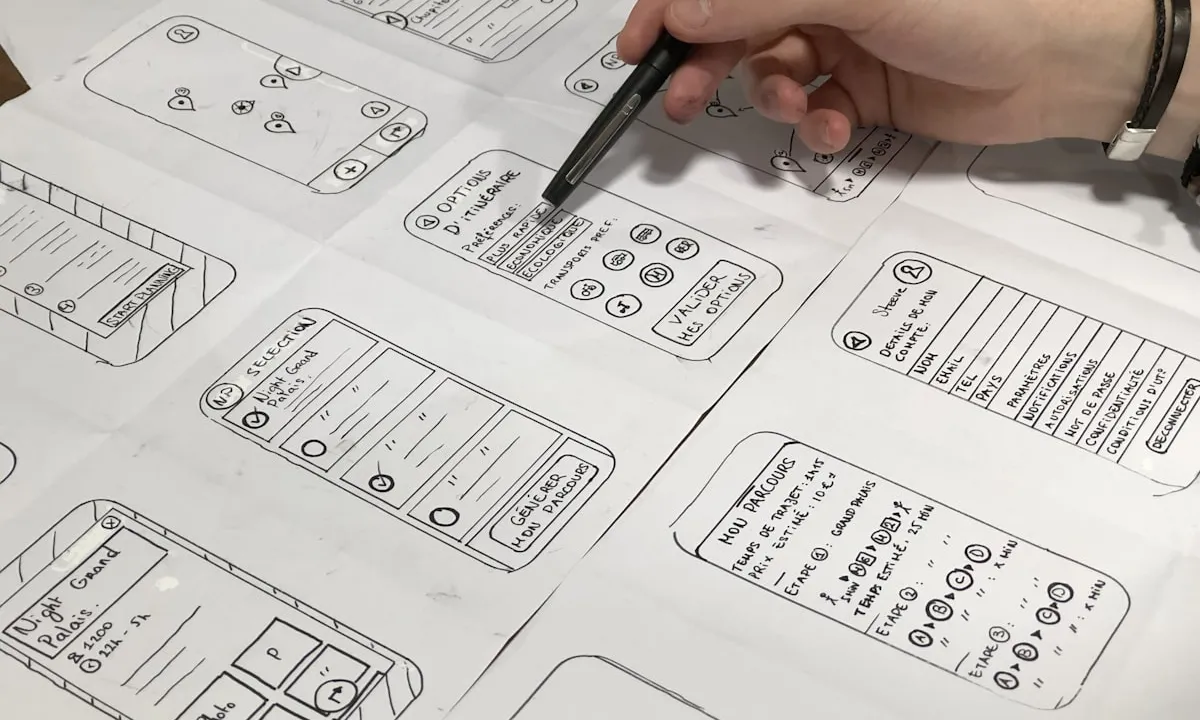
For PSONI, the Polish Association for Persons with Intellectual Disability, Generator ETR turns difficult text into easy-to-read language. ETR stands for easy-to-read. The proof of concept ran PLLuM 12B, a Polish language model, and the 26B mixture-of-experts version of Gemma 4 (a design that uses only part of the network for each answer) on the same task. We chose Gemma 4.
A script scores every output with the Gunning Fog readability index and writes a report over a set of test samples. A reviewer who knows the ETR standard then rates the results against the source texts. What they find goes into the next iteration of the prompt and the model, and the fifth iteration is under way. Our page on LLM evaluation describes the method.
The model is one part of the product
From proof of concept to MVP: what we add around the model
An MVP puts the model in front of real users, so it needs a backend, user accounts and web and mobile apps around it.
In Generator ETR: Django and Celery on the backend, React and React Native in the apps, the model served by vLLM on rented GPU servers.

In Generator ETR users sign in with an account verified by SMS. They can take a photo of a letter, and the phone reads the text on the device using Google ML Kit and Apple Vision, while PDF documents go through a pipeline on the server. A glossary explains difficult words. Text-to-speech reads the result aloud and highlights the fragment being read, and a counter shows how many requests a user has used.
The project specification requires the app to meet WCAG 2.2 at level AAA.
Statistical models on a company's own sales data
A second example: forecasts that say how sure they are
For a company in the live events market we build forecasts of final ticket sales. Every number from the model comes with an interval and its basis.
When fewer than 5 comparable finished sales curves exist, the model gives no forecast.

We cannot name this client, and the project is still in progress. We began in September 2026 with a short spike, a time-boxed study of the data sources. Then we connected ticket sales data from several sources and the client's spreadsheet to a data warehouse, using dlt, dbt on ClickHouse and Dagster for orchestration.
A sales curve shows how ticket sales built up over time for an event that has already ended. The models forecast an event's final sales from comparable finished sales curves, with an empirical interval. They also calculate the sales pace against the median of comparable events, the risk of selling out and anomalies in ticket baskets. The analysis covers the effect of weather on attendance and sales too.
The results go to a portal with an event list, a sales plan and a "how it's going" rating, with user accounts and roles. The portal runs on Django with DRF and Next.js.
Quality measures, backtests and accessibility checks
How we test an AI MVP
MVP testing for an AI product has to cover the model as well as the app.
The quality measures agreed for the proof of concept keep running once users arrive.
- Model quality: the measures from the proof of concept keep scoring every new iteration. Our QA also runs jailbreak tests, which are attempts to push the model off its task, and repeats them on new iterations.
- Forecasts: in the forecasting project a recommendation passes a model gate and a backtest before it reaches the portal. A model gate is a check the recommendation must pass before users see it, and a backtest checks the model against sales that have already ended.
- Accessibility: in the later stages of Generator ETR we check accessibility with screen readers and in the DOCX files the app generates.
When we advise against a language model
Not every AI MVP needs a language model, and sometimes our advice in discovery is to skip it. In the forecasting project, statistical models on the client's sales data solve the task.

How the work is split into stages and what you own
Copyright to the code passes to you with each payment, for the uses the contract lists. PSONI owns the code of Generator ETR. After launch we stay on for support and maintenance, because models, prompts and data keep changing.
Generator ETR runs on a 24-month agreement, from February 2026 to February 2028, split into 8 stages. The project is now in stage V. We answer the contact form within 48 hours on working days.
Why build your AI MVP with us
For PSONI the same team writes the prompts, evaluates the output and builds the web and mobile apps. In the forecasting project we are building the data warehouse, the models and the portal. Every project starts with a free discovery workshop, where we agree what the AI should do and which test will show that it works.
Have an idea for an AI feature and no proof yet that a model can do it? Start with a free AI discovery workshop.
Do you have questions?
AI MVP development: frequently asked questions
-
An AI MVP is a first AI product for real users, built once a proof of concept shows the model works on your data. It needs more than the model: a backend, accounts and web and mobile apps. We build both stages, and every project starts with a free discovery workshop.
-
An AI proof of concept, or AI PoC, is a small project that answers one question: can a model do this task well enough on your data? The test samples and quality measures are agreed before the first prompt. The result is a decision and a chosen model, not a finished product.
-
A proof of concept tells the project team whether the model can do the task. An AI MVP puts the model in front of real users, with a backend, accounts and web and mobile apps around it. The quality measures from the proof of concept keep running after launch.
-
We test the candidates on the same task and compare the results with the agreed measures. For PSONI we ran PLLuM 12B, a Polish language model, and Gemma 4 on the same text simplification task, and we chose Gemma 4.
-
With a metric and a reviewer. For PSONI a script scores every output with the Gunning Fog readability index over a set of test samples, and a reviewer who knows the ETR standard rates the results against the source texts. The findings feed the next iteration of the prompt and the model.
-
We test the model and the app. The measures from the proof of concept keep scoring every new iteration, and jailbreak tests try to push the model off its task. Forecasts pass a model gate and a backtest, and in Generator ETR accessibility is checked with screen readers and in the DOCX file the app generates.
-
Not always. Our sales forecasting project runs on statistical models over the client's sales data. Sometimes our advice in discovery is to skip the language model altogether.
-
Every number from the model comes with an interval and its basis. When fewer than 5 comparable finished sales curves exist, the model gives no forecast. Recommendations pass a model gate, a check they must clear before users see them, and a backtest.
-
A sales curve shows how ticket sales built up over time for an event that has already ended. The model in our forecasting project works from comparable finished curves, with an empirical interval. When fewer than 5 of them exist, it gives no forecast.
-
A backend, user accounts and web and mobile apps. In Generator ETR that means accounts verified by SMS, text recognition from photos on the phone, a PDF pipeline on the server, a glossary of difficult words, read-aloud with highlighting and a counter of used requests.
-
We do. For PSONI we are building Generator ETR, a web and mobile app around a model chosen in a proof of concept. For a company in the live events market we are building sales forecasts and a portal. Every project we take on starts with a free discovery workshop.
-
Yes. On PSONI the same team writes the prompts, evaluates the output and builds the web and mobile apps. In the forecasting project we are building the data warehouse, the models and the portal.
-
We stay on for support and maintenance, because models, prompts and data keep changing. The quality measures from the proof of concept keep running after launch, and copyright to the code passes to you with each payment, for the uses the contract lists.
-
With a free discovery workshop. We look at your product, your data and your rules, agree what the AI should do and which test shows that it works, and you leave with a scope and an estimate. Book it and we reply within 48 hours on working days.
-
You do. Copyright to the code passes to you with each payment, for the uses the contract lists. PSONI owns the code of Generator ETR.

AI MVP development, from the first test to the first users.
Your message goes to

Filip Szamborski
Co-founder & CEO

Your message goes to

Karol Oponowicz
Co-founder & Business Owner
Your message goes to

Paweł Zieliński
Co-founder & Business Owner
SO FAR WE HAVE WORKED WITH BRANDS LIKE:




Thank you for your message.
We read every message ourselves and get back to you within 48 hrs on business days.
Something urgent? hello@ordergroup.co