The Present and the Future of Wind Energy
Aleksander Jess, Former Copywriter | | 4 min read
The brief
Wind turbines work day and night, convert 35–45% of wind energy into electricity versus 18–22% for solar panels, and leave most of the land usable. The article covers their history, these advantages, and what still holds wind power back: cost, energy storage, setback laws that differ across Europe, public perception, and recycling.
History
The History of Wind Turbines
Interestingly, wind turbines are older than you would think.
Ancient Greeks were the first to engineer a wind-powered machine, in the 1st century AD. From the 7th to the 19th century, windmills were used in what is now Iran and Afghanistan to grind grain and pump water.
Vertical windmills, used for grinding grain, started to spread in northwest Europe towards the end of the 12th century. For generations, windmills popped up all across the European continent; think of the Netherlands and its efforts to reclaim land from the sea.
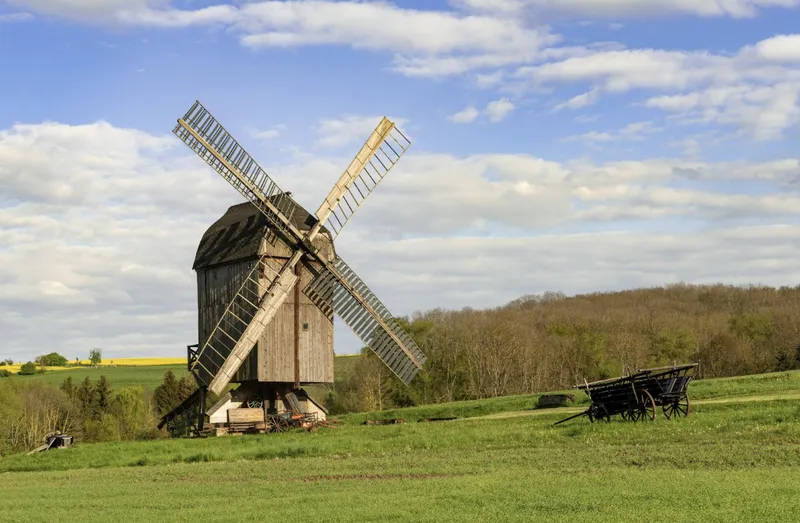
In the late XIX century, wind turbines began to be used to generate power. An Austrian engineer created the first known wind turbine for power generation in 1883; the same structures were later built in Scotland and the United States in the late 1880s.
Early wind turbines were tiny and unreliable, but turbine design and materials developed over the 20th century. This led to larger, more efficient wind turbines capable of generating commercial power, and in the 21st century they became a driving force behind the shift to green energy.
Expectations
Why Are Wind Turbines So Promising as a Technology?
Firstly, the technology is so effective because, unlike solar panels, wind turbines work at night as well as during the day. Sure, there are low-wind periods, and turbines need a minimum wind speed (usually around 3 m/s) to start generating power, which is why energy storage matters.
Secondly, these large "fans" are relatively cost-effective. While the cost of raising a huge structure might be high, they generate much more electricity than solar panels. In fact, a single wind turbine can generate the same amount of electricity as seven football fields of solar panels. This means wind power has a much higher energy density. Wind turbines typically convert around 35-45% of wind energy into electricity (the theoretical maximum, known as the Betz limit, is 59.3%), while solar panels typically convert only 18-22% of solar energy into electricity. The Sun gives us a lot of energy, but we can't convert it into electricity efficiently, yet.
Another advantage is the obvious one. By generating electricity from wind, we lessen our dependence on fossil fuels, which are finite resources with geopolitical and environmental complications. This improves energy independence and security, while also reducing our contribution to global warming.
There are also the economic benefits of a whole new industry. Wind farms create jobs in manufacturing, construction, and maintenance. Landowners who lease land for wind turbines also often receive payments, which benefits rural communities.
Lastly, wind turbines have a relatively small footprint on land. They can coexist with agriculture and grazing, and the land beneath them can still be used for other purposes.
What Needs to Change?
While wind energy has undeniable advantages, there are some hurdles to it becoming even more widespread and popular.
Cost Effectiveness
Although wind energy has become more cost-effective, there's still room for improvement, especially when compared to heavily subsidized fossil fuels. Technological advancements to reduce manufacturing and maintenance costs, along with consistent government policies supporting renewable energy, could make wind a more attractive option.
Storing Surplus Energy
Wind is a variable resource, meaning it doesn't always blow. Large-scale, cost-effective energy storage is needed to balance the grid and keep the electricity supply reliable when wind speeds are low. That requires advances in battery technology or alternative storage methods.
Laws
Currently, European countries have different laws on the placement of wind turbines with respect to other buildings and on generated noise levels.
- Poland: In 2023, Poland revised its restrictive "10H" rule, which required a minimum distance of 10 times the turbine height between wind turbines and housing. The new regulation allows for a minimum setback distance of 700 meters, though industry groups had advocated for 500 meters.
- Germany: Setback distances in Germany vary by state. Some states require distances of 1000-1250 meters, while others have shorter setbacks of around 700 meters.
- Denmark: Denmark sets the minimum setback from turbines to homes at 4 times the total turbine height. If the distance is less than 6 times the total height, homeowners may apply for compensation from the developer for loss in home value.
- Sweden: Sweden limits noise to 35 dBA in recreational areas in the evening and at night, and to 40 dBA in residential areas at night.
- United Kingdom: While there's no national standard, some recommendations suggest setbacks of 500-600 meters. The UK Noise Association has suggested a more conservative 1600 meter setback.
Public Perception
Wind turbines are gaining acceptance, but some public concerns remain, including noise, the visual impact on landscapes, and potential risks to birds. Improved turbine design, responsible siting, and open communication with communities can address these concerns and help win wider public support. Perhaps it's time to reevaluate priorities: protecting wildlife is important, but so is reducing carbon emissions, which will also save lives.
Recycling
While wind energy is clean during operation, manufacturing and decommissioning wind turbines can have some environmental impact. It's even worse when you use batteries to store surplus renewable energy. Sustainable materials and responsible end-of-life practices can minimize this impact. We also expect new processes to emerge that will make this much more environmentally friendly. We must also set and enforce policies that ensure turbines and batteries are recycled responsibly.
Conclusion
There is huge interest in solar & wind energy. Laws are changing around the world, and they must change, as most European countries, apart from Norway and Sweden, have a long way to go to achieve net zero emissions.
Challenges remain, from cost reduction to energy storage, but advances in technology, better regulations, and open communication with the public can pave the way for a future powered by wind.
Let's work together and shape the future
Contact usMore articles about Energy
Molten Salt Batteries - Salt in Batteries?
Custom Web App Development for the Energy Industry