User Journey Mapping in Practice. Part 1: What? When? and How to Set Up the Workshops?
Karol Oponowicz, Co-founder & Business Owner | | Updated | 4 min read
The brief
User Journey Mapping (UJM) is one of the exercises that really helps to structure the UX design. In UJM we look at the user needs and behaviors from different angles and perspectives. In UJM, you use carefully organized workshops to learn and discover different layers of information about your user & product context. This allows us to find the best user interface solutions that can deliver your value to the customer. Here's how we understand and use UJM in practice.
User Journey Mapping is part of our Product Design workshops.
When to Use UJM Workshops?
Here are the situations when a User Journey Mapping workshop can benefit your company or project the most:
- When you plan to launch a new product or a new feature.
- When you want to introduce a new flow to your existing product.
- When you'd like to run an audit on your current UX (or business) process.
- When you are looking for a new strategy and considering a pivot for your product.
- When you need to create new KPIs for measuring performance.
- When you need to verify your users' needs and the product's pain points.
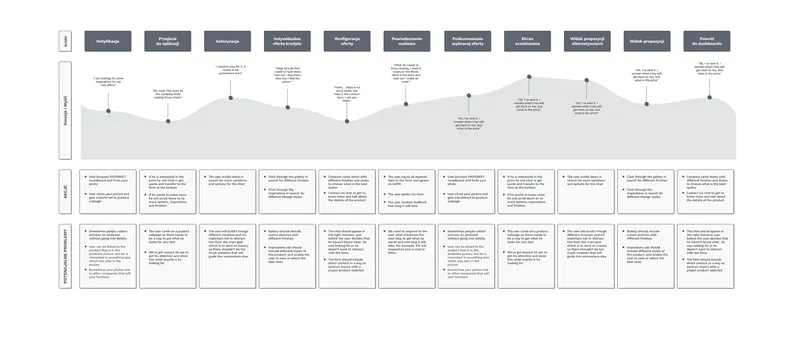
UJM is a workshop methodology that can significantly improve the organization of your knowledge. We've been using this framework for several years, and each time our clients have the opportunity to learn something new about their customers (users) and themselves.
We have applied UJM in different projects, both for startups coming up with new innovative products and for corporations with developed, established systems, where we often took over just part of the development process. We've done it in different industries, for clients from Istanbul, London, Oslo or Warsaw.
From this experience, we learned that although the mapping methodology is well proven and you can do 60% of the workshop "by the book," a good team still needs to improvise around 40% of the time. Why? UJM is a complex and creative process because some pieces of the puzzle are usually missing and you need to figure out how to fill in the blind spots. For example, sometimes no one in the room knows the answer to a specific tech issue, and then you need to speculate a bit. It's also a process where the interaction between participants can have a major effect on the product. That's why you almost always need a highly skilled facilitator to make the most of the workshops.
A great UJM team knows how to do it by the book, but also knows how to improvise. By far the most effective way of having a workshop is to have everyone in one room. If it's not possible for everyone to meet face to face, then we can run the workshop remotely over a video call.
Setting Up a UJM Workshop
The workshops last one or two days. To get satisfactory results from the workshops, you probably need at least one or two weeks to prepare. First of all, you need to gather all the necessary information, like business goals that can be set and measured easily: reducing service time, increasing profit, attracting new users, etc. To do it right, you need to ask the client directly and try to find answers to these key questions:
- What is the client's biggest motivation behind the product's development?
- What existing problem would you like to solve by creating this product?
- How (exact steps & actions) is your product going to fix that problem?
- How are you going to measure your product's performance & success?
- How are you going to check and validate whether your product is needed?
- What is your product's value proposition and is it valuable to the user?

Client Interview
We arrange a meeting with our client to clear up any missing topics. Here are some critical questions we usually ask.
What are your key business goals and motivations? What is the competence of your team and organization?
From our perspective, there are two different groups of clients. The first is product owners who know their business perfectly. They have unique insights into the market and can efficiently act as an example of a User Persona (UP). The second group is investors who want us to deliver the know-how.
What are the roles of the project's stakeholders, and how does the decision-making process work? How many people take part in it?
What is the chain of command, and how can it be adjusted to the agile development approach? How frequently can we communicate? It's a big difference whether we are going to talk every hour or once a week.
And finally, we ask if you know who your User is. What are your product's User Personas?
In the next parts of our guide to User Journey Mapping, you will get to know the key facts about User Personas, learn how to build your own UJM, and see examples of UJM workshops we ran with our clients.
Pre-Workshop Briefing
These questions are just the beginning of a proper, well-written Workshop Brief, which is indispensable for a successful UJM workshop. There are still some essential elements of the project that you need to set before you run the workshops. Here are the most important ones to include.
The list of critical functionalities. It should be minimal, and you should ask yourself "is it the thing they need?" every time you plan to add a new feature.
Project's timeline, stages, and current status. Sometimes the project has had a previous release, and investigating it usually brings us a lot of useful insight.
Preferable tech stack. Sometimes the teams we work with are already attached to an idea of the technology they'd like to use. You need to verify whether it's indispensable. The decision about technology should be made after the UJM process.
The marketing and communication strategy. Understanding your audience, users, and customers is essential.
There is more to set with the client, so here is the extended briefing routine that we use in the projects we develop. The first column contains all the topics that we usually cover in our briefing.
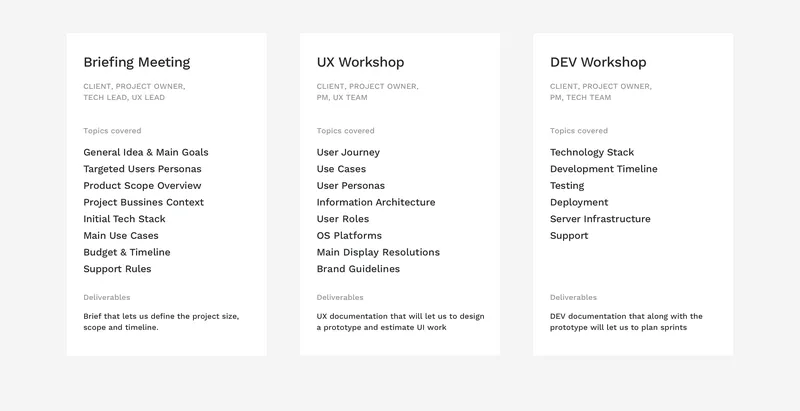
OK, the Briefing is done. Now it's time to talk about the User Personas!
Continue to Part 2
Do you want to talk about your Users' needs with UX specialists?
Let's talk!More articles about Product & discovery
Benefits of Time and Materials (T&M) Pricing Model for Software Development

Choosing the Right IT Outsourcing Team