Industrial IoT Examples: 5 Projects From Airports to Energy Storage
Maciej Sułek, Co-founder & CTO | | Updated | 9 min read
The brief
From airport lights with an IoT module on every controller to battery sites that keep running without the internet: five systems we built and what each one taught us.
Industrial internet of things (IIoT) examples include IoT modules on airport light controllers, aircraft tracking from induction loops and transponders, and offline battery control. Below are five projects we built, from airport systems to a thermal energy storage plant, a portfolio of solar and battery sites and home batteries, with what each one connects, what the software does and what we learned. If you are planning a system of your own, our page on industrial IoT services shows what we build and how a project starts.
Industrial IoT examples at a glance
The list below shows what each of the five projects connects and what its software does.
- Monster (aviation): every airport light's controller has its own IoT module; a dashboard and alerts by role serve the control tower and the technical team.
- ATOS (aviation): data from induction loops and transponders gives the real-time position of aircraft and airport vehicles, in a system built for CAT III B operations.
- KYOTO (thermal energy storage): a SCADA-based system and digital twin that monitors and controls the flow of energy in real time, built over three and a half years.
- Skyfri (solar and battery): an energy management system (EMS) that runs fully offline and controlled more than 5 MWh of battery storage across 7 plants.
- Zeronest (home solar and batteries): a device wired to the inverter over RS-485/Modbus reports over LTE, and the platform supports 16 inverter brands.
1. Airport lighting with an IoT module in every light: Monster
Monster is a lighting management system for airports in western Poland, built with AP-TECH. Air traffic controllers use it to set the direction and brightness of each airport light.
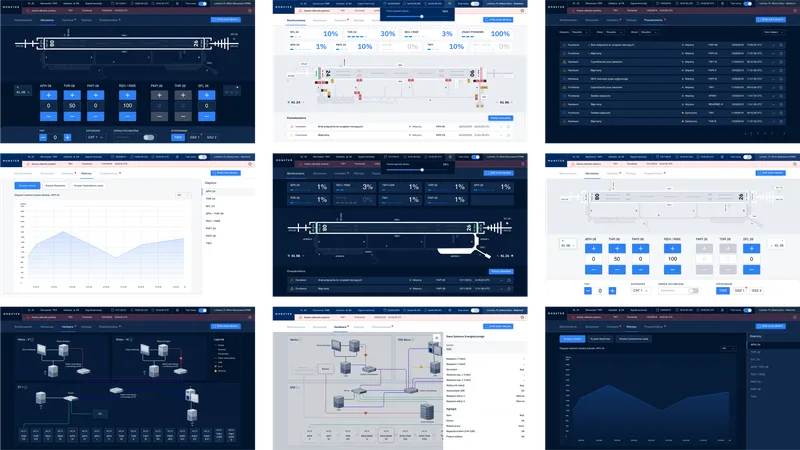
What is connected. We integrated each light's controller with a separate IoT module, so the lighting can be managed and monitored from multiple workstations.
What the software does. The dashboard, built with Django, gives controllers real-time information about battery levels, power supplies, connectivity and the status of UPS devices. A role-based hierarchy follows air traffic control procedures. The control tower gets basic alerts such as "low temperature", while the technical team gets detailed reports and tasks that need immediate action.
What we learned. The extended analysis during the planning stage paid off in a system, built with Python, Go and Apache Kafka, that can scale and be adapted to other airports.
Result. Monster replaced legacy software at the airport. Read the Monster case study for the full story.
2. Aircraft and vehicle tracking in fog: ATOS
ATOS (Airport Technologies Operational System) tracks aircraft and airport vehicles in real time so that controllers can keep runways clear in near-zero visibility. We built it with AP-TECH for one of the main airports in Poland, for CAT III B operations.
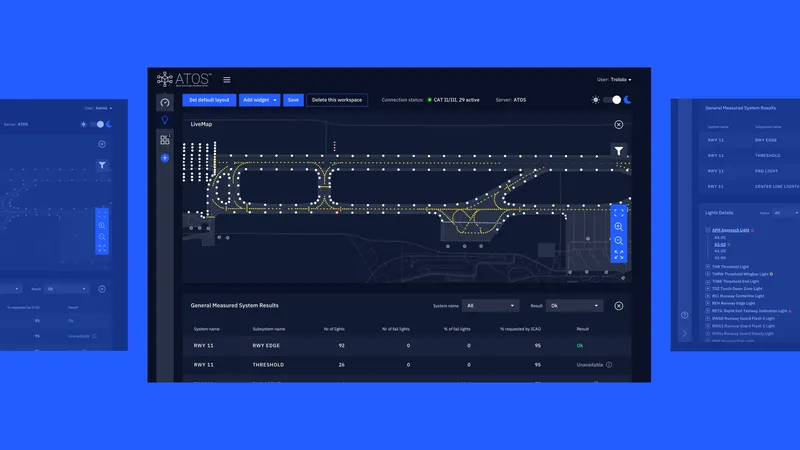
What is connected. ATOS combines data from induction loops and transponders into one picture of the airfield.
What the software had to do. CAT III B operations require the system to track every aircraft and vehicle on the airfield in near-zero visibility, with no room for stale data, and to pass review by aviation authorities. Controllers work in a custom dashboard that shows the real-time position of airplanes and vehicles, so they can manage traffic and react to unusual activity.
What we learned. Meeting the requirements of aviation authorities took rigorous testing and tuning, often in the early morning hours.
Result. The project contributed to AP-TECH's place in the Deloitte Technology Fast 50 ranking. Details are in the ATOS case study.
3. A digital twin for thermal energy storage: KYOTO
For Kyoto Group we spent three and a half years on industrial IoT and digital twin software for the Kyotopia project. Kyotopia moved from solar energy production to thermal energy storage in molten salt. The work started as a UX/UI MVP and grew into a SCADA-based system that monitors and controls the flow of energy in real time. Requirements kept changing along the way, and our team made frequent trips to Oslo for hands-on collaboration.
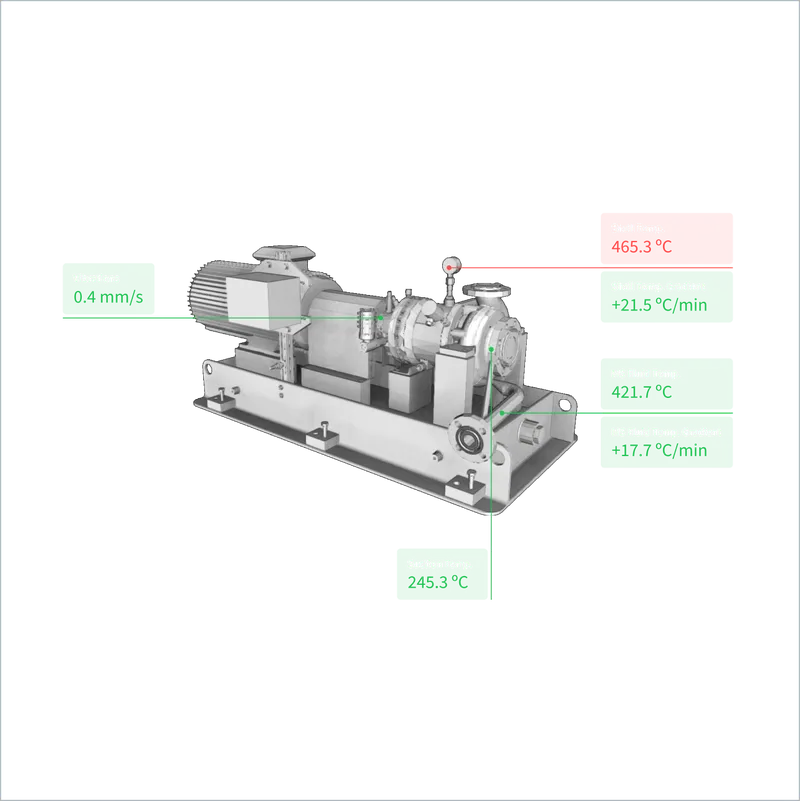
What is connected. The hard part was connecting complex physical hardware to software. Our scope included control of the thermal store integrated with the plant's SCADA layer, and surveillance with infrared cameras and image recognition working alongside it. Augmented reality elements in the operator's camera view present key plant data.
What the software does. The system includes surveillance functions, weather data collection, energy price analysis and a plant performance simulation interface. In 2024 the team also worked on a web platform for planning where future solar thermal plants should go and for simulating their performance and cost from data such as solar irradiation and terrain. The stack was React.js, Python and AWS, with Terragrunt and Jenkins for the infrastructure.
What we learned:
- Plant data ran through an industrial data platform whose functions were enough for tests and prototypes but caused problems in long-term use. For production logic we would choose a more mature runtime next time.
- Streamlit worked well for proofs of concept.
- Putting OIDC login to Azure Entra ID on the AWS load balancer took authentication out of the applications.
- Role-based access for the dashboards was difficult to configure and did not hold up well over time, so plan roles early.
Result. Our software supported the prototype Kyoto presented to investors. In the first half of 2021 Kyoto raised NOK 183.3 million in private placements. More in the KYOTO case study.
4. Solar and battery sites that keep running offline: Skyfri
Skyfri runs an asset management platform for solar and battery portfolios. Skyfri Intelligence handles monitoring and data, and Skyfri SolarSCADA handles site-level hardware control. We designed and built the EMS underneath both: the control logic for the batteries and inverters on each site.
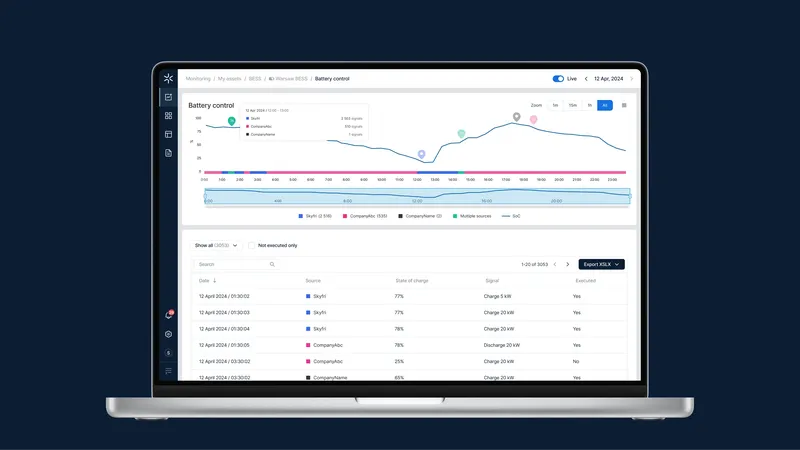
What is connected. A real portfolio rarely runs on one brand, and the EMS controls batteries and inverters from several manufacturers at once. It includes Modbus communication modules next to battery and PV control. The work on them started with communication workshops with the battery supplier in February 2024. The platform connects to the sites through Azure IoT Edge and Azure IoT Hub.
What the software does. The EMS decides when batteries charge and discharge, runs peak shaving and energy trading, and responds to requests from the local distribution system operator (DSO). A site load limiter keeps exports under the grid connection limit. The EMS runs fully offline, because a control decision on a live battery cannot wait on a dropped connection. The stack is a React frontend, a Python asyncIO backend and a Databricks data pipeline, hosted on Azure.
What we learned. A Technical Feasibility Study in November 2023 (market analysis, feasibility and technical specification) came before any commitment to a build, because the platform had to work with hardware and site conditions the team did not control. From January 2024 our engineers and Skyfri's team worked as one unit, and they kept working together after launch.
Result. The EMS went into production in June 2024 and ran across 7 solar and battery plants. It controlled more than 5 MWh of battery storage and monitored more than 1 MWp of solar capacity. Skyfri and Order Group then scoped a new EMS project for Hydro Rein, Skyfri's own end customer. See the Skyfri case study.
5. Inverter data over Modbus and LTE: Zeronest
Zeronest serves homes, installers and energy cooperatives, but its data layer follows the same pattern as an industrial site. That means its own device on site, a wired connection to the equipment and a link that does not depend on the home Wi-Fi or the manufacturer's cloud. We have been building Zeronest's EMS since January 2024, and it has run in production since June 2024.
What is connected. Every installation gets a Bzyk D200 device with its own SIM card, wired directly into the inverter over RS-485/Modbus and reporting over LTE. It works independently of the inverter manufacturer's cloud and the homeowner's Wi-Fi, and Zeronest states that it mounts on a standard DIN rail in about 15 minutes. Devices talk to the cloud over MQTT and TLS 1.2 behind AWS IoT Core, and client data stays in the EU.
What the software does. Every minute, a fresh reading of production, consumption and battery state is combined with day-ahead and intraday market prices, distribution tariffs, grid operator signals and the weather forecast. The result is one decision: charge the battery, discharge it or sell to the grid.
What we learned. Building our own data layer was harder than calling each manufacturer's API, but the system stays online when a manufacturer's API goes down or a home network drops. The platform now integrates 16 inverter brands, including Deye, GoodWe, Hoymiles and Sungrow. Configuration registers are checked by a daily read-write-read cycle per inverter model: the system reads the values, compares them with the target, writes them, reads them again and raises an alert when the read-back differs.
Result. The platform serves several thousand users. A steady team of seven people logged some 11,220 hours in its first two years. More in the Zeronest case study.
What these industrial IoT projects have in common
These projects share five traits: third-party equipment, control without the internet, role-based alerts, checked writes to equipment and work that continues after launch.
- Most of the equipment came from someone else. Light controllers, induction loops, transponders, a thermal plant, and inverters and batteries from several brands: each needed its own integration before any dashboard could show useful data. The exception is Zeronest's own Bzyk D200, and even that device is wired to inverters from 16 brands.
- Control does not depend on the internet. The Skyfri EMS keeps controlling batteries and inverters offline, and the Zeronest device reports over its own LTE link without the home Wi-Fi.
- Alerts depend on who reads them. Monster sends basic alerts to the control tower and detailed reports to the technical team. On KYOTO, role-based access for the dashboards was hard to configure and did not hold up well, so we now plan roles at the start.
- Writes to equipment are checked. Zeronest reads each configuration register back after writing it and raises an alert when the value differs.
- The work continues after launch. The engineers who shipped the Skyfri EMS kept working alongside Skyfri's team after launch, and the Zeronest platform has been built by the same team since January 2024.
Questions about industrial IoT examples
What is an example of industrial IoT?
An airport lighting system in which every light's controller has its own IoT module is one example. In Monster, which we built with AP-TECH, air traffic controllers set the direction and brightness of each light, and a dashboard shows battery levels, power supplies, connectivity and UPS status.
What are examples of industrial IoT devices?
Industrial IoT devices are the field hardware that software reads data from or sends commands to, from light controllers to batteries and inverters. Examples from the projects above: IoT modules on airport light controllers (Monster), induction loops and transponders on an airfield (ATOS), infrared cameras at a thermal energy storage plant (KYOTO), batteries and inverters on solar sites (Skyfri) and a Bzyk D200 device wired to a home inverter over RS-485/Modbus (Zeronest).
How long does an industrial IoT project take?
In our projects, from months to years. For Skyfri, a Technical Feasibility Study in November 2023 was followed by an EMS in production in June 2024. KYOTO grew from a UX/UI MVP into a SCADA-based system over three and a half years.
How does SCADA fit into an industrial IoT system?
In our projects SCADA is one layer of the system. It collects data from local controllers, shows it to operators, raises alarms and passes on their commands. KYOTO's system is SCADA-based. On Skyfri's platform, SolarSCADA handles site-level hardware control, and the EMS we built holds the control logic.
Planning an industrial IoT system? See what we build and how a project starts.
See industrial IoT services