Benefits of Time and Materials (T&M) Pricing Model for Software Development
Karol Oponowicz, Co-founder & Business Owner | | Updated | 6 min read
The brief
Fixed Price vs. Time & Materials
Choosing the right pricing model for your software development project is an important decision. While the traditional fixed-price (FP) model might seem appealing at first glance, it often proves less suitable than the time and materials (T&M) approach. This post explains the advantages of T&M and why it usually leads to more successful and collaborative software development.
Understanding Fixed vs. T&M
Here are the main differences between the two most common pricing models:
- Fixed Price (FP): In this model, the development agency provides a client with a predetermined, final cost for the entire project. This price typically includes a buffer (up to 30%) to account for unforeseen circumstances. However, the accuracy of this estimate hinges on a well-defined initial project vision documented in a Product Requirements Document (PRD). The FP model can be likened to a traditional construction contract, where blueprints are finalized before construction begins.
- Time & Materials (T&M): Here, clients pay for the actual time developers and project members dedicate to the project, along with any necessary resources like frameworks or hosting. This model offers greater flexibility as the project evolves, similar to hiring an hourly consultant who adapts their services to your specific needs.
Why Fixed Price Fails
Clients often gravitate towards fixed-price models due to a desire for budget certainty. However, this approach can be risky for software development projects. Imagine arriving in a new city and asking a local contractor to renovate a house neither of you has fully explored yet - a fixed price for such a project would be highly speculative. You can't plan a project well without properly exploring the metaphorical house.
The FP model relies on a clear vision of the final product, which can be hard to achieve, especially for non-technical founders or startups. What's more, the ever-changing nature of software engineering makes it difficult to predict every step at the outset. Fixed-price contracts often penalize changes to the original idea, leading to additional costs. This can be frustrating, like discovering midway through the renovation that the plumbing needs a complete overhaul, which wasn't included in the initial fixed price for the house.
The T&M Advantage
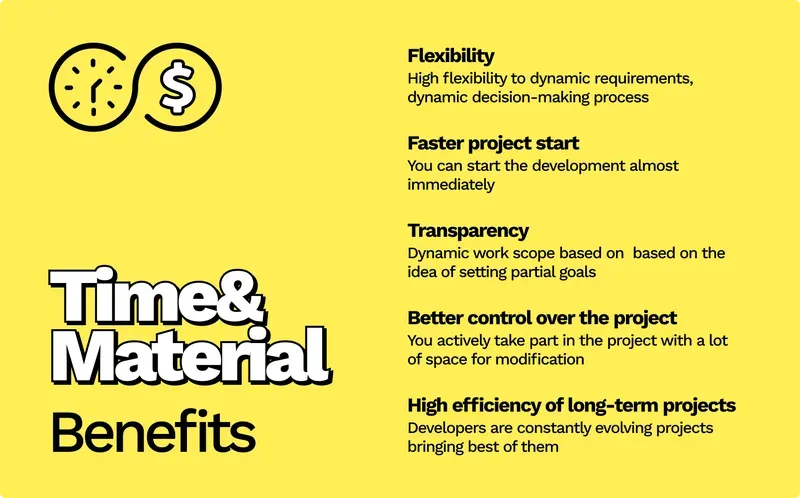
While the financial transparency of the fixed-price model might seem attractive, T&M is often the more cost-effective and lower-risk option, and it tends to lead to a better product. Here's why:
Faster Start
T&M eliminates the lengthy process of creating fixed-price estimates, so your software development agency can start work sooner.
With T&M, clients prioritize tasks in a backlog, which allows a more agile approach. Imagine you're planning a road trip - a fixed-price contract might be difficult to create if you're open to exploring new detours along the way. A T&M approach allows you to budget for gas and map out the general route, but also take that spontaneous turn onto a scenic backroad. With a fixed price, you will (often) know how much you will spend, but you won't have the opportunity to explore unknown places, which can turn out to be gems.
Flexibility and Control
T&M makes the development process dynamic. Clients can actively participate, propose modifications, and add new features without significant roadblocks or additional upfront costs. This fits agile methodologies like Scrum, which emphasize continuous improvement through client feedback. Think of it like chartering a boat for your island vacation. With a fixed-price cruise, your travel plan is set. A T&M contract lets you steer the course along the way, deciding to linger longer at a beautiful beach or detour to check out some hidden coves.
Transparency and Collaboration
Agile methodology in software development, often used with T&M, promotes transparency. Clients receive regular updates through sprints (short development cycles) and participate in reviews, ensuring the project stays on track and meets their needs. Imagine working with a local architect who keeps you updated on the construction progress and welcomes your input throughout the renovation.
There's one more issue. With the Fixed Price model, the software development company must assume a safety margin, just in case something goes awry. Sometimes that's as much as 30% of the total deal.
A More Engaged Development Team
T&M gives developers a reason to be more invested in the project's success. Besides executing the plan, they can use their expertise to suggest improvements and new solutions as the project unfolds. In a T&M scenario, the developers are like your personal sous chefs in the kitchen. Besides following your recipe, they can suggest ingredient substitutions or new flavor profiles to improve the final dish.
When T&M Reigns
Adding to the benefits, there are certain scenarios where the T&M model is the only viable option:
- Long-term Projects: For projects exceeding six months, the inherent uncertainty of long-term development makes fixed-price estimates unreliable. Imagine building a house - the cost can fluctuate depending on unforeseen factors like weather delays or discovering unexpected structural issues. A T&M approach allows for adjustments as the project progresses, like accommodating a change in building materials due to a supplier shortage.
- Uncertain Scope: If the project is based on a rough idea lacking technical details, a fixed price is impossible to determine accurately. Imagine renovating your attic - you might discover hidden beams or electrical wiring that necessitate changes to the initial plan. A T&M model provides the flexibility to address these unforeseen circumstances.
- R&D and Innovative Projects: Research and development projects with unpredictable outcomes or those using cutting-edge technology in a dynamic market are best suited for T&M. Imagine developing a new type of sports equipment. A fixed price wouldn't account for the possibility of needing to redesign a component based on user testing. T&M allows for these pivots as the project progresses.
- Startup Projects: Startups often have evolving ideas and limited resources. The T&M model enables them to build a minimum viable product (MVP) first, gather user feedback, and iterate without being locked into a fixed-price that may not accommodate necessary changes. Imagine testing a new restaurant concept - you'd likely start with a limited menu and adjust it based on customer preferences. T&M allows startups to do the same with their software product.
Fixed-Price Niche
While T&M offers numerous advantages, fixed-price models can be relevant for specific software projects:
- Simple, Well-Defined Projects: For projects with a clear scope and minimal complexity, like replicating existing applications, a fixed price can be appropriate. Imagine building a shed in your backyard - the materials and construction process are fairly standardized.
Choosing the Right Path
The best pricing model depends on your specific project needs and risk tolerance. Consider these questions when deciding:
- Project Scope: How well-defined is your project concept?
- Project Duration: How long will the project take to complete?
- Development Complexity: Does the project involve unfamiliar technologies or unforeseen challenges?
- Client Involvement: How much control and input do you want in the development process?
By weighing these factors and understanding the strengths and limitations of both T&M and fixed-price models, you can make an informed decision about your software development project.
Choosing T&M is like traveling with a skilled guide: you have a roadmap, but you can still take unplanned detours, and some of them lead somewhere better than you expected.
Let's Talk About Your Project - FP or T&M
Contact Us