Energy Glossary
Key energy terms explained in plain language
-
Material consisting of hydrocarbons coming from the crust of the Earth. Created from the remains of dead plants over long periods of time. Largely responsible for the global warming crisis.
-
A hydrocarbon is a type of organic compound that is composed entirely of hydrogen and carbon atoms. In the fossil fuel industries, the term hydrocarbon is used to describe naturally occurring substances such as petroleum, natural gas, and coal, as well as their derivatives and purified forms. The combustion of hydrocarbons is the primary source of energy worldwide. Petroleum is the primary source of raw materials for the production of organic commodity chemicals like solvents and polymers. The majority of human-generated greenhouse gas emissions come from either the burning of fossil fuels, which releases carbon dioxide, or the handling of natural gas and agricultural activities, which release methane.
-
Energy from sources that replenish quicker than they are used. Examples include solar, wind, hydro, geothermal, and biomass.
-
Energy obtained from nuclear reactions, typically used in nuclear power plants to generate electricity. The process involves either splitting atomic nuclei (fission) or combining them (fusion), which releases a large amount of energy. Nuclear energy offers high energy efficiency and low greenhouse gas emissions, but it also raises challenges related to radioactive waste and safety.
-
A unit of measurement for the amount of thermal energy required to raise the temperature of one pound of water by one degree Fahrenheit. It is used to determine the energy content of fuels and the effectiveness of heating and cooling systems. One Btu equals approximately 1,055 joules.
-
A unit of energy equal to a power of one kilowatt (1 kW) used for one hour. It is commonly used to measure the electrical energy consumed by households and businesses and is the basis for electricity billing. One kWh is the energy consumed by running a 1,000-watt device for one hour.
-
A barrel of crude oil equivalent (BOE) is a unit of energy equal to the energy produced by burning one barrel of crude oil. The energy industry uses it to express different forms of energy in a single unit, which makes financial analysis and calculations more straightforward. One BOE equals approximately 5,800 cubic feet of natural gas or 1.7 megawatt hours of electricity.
-
A digital twin is a virtual replica designed to precisely simulate a physical entity, operation or system. It is used to emulate, predict, improve and track functionality through real-time data analysis and monitoring.
-
The Internet of Things (IoT) refers to a collection of physical devices, ordinary objects or appliances equipped with sensors, software and other technologies. These devices can connect and communicate with each other via the internet or other communication networks, and they can collect and share data autonomously.
-
A power plant is an installation or a building used to generate electricity, which is then sent out.
-
A network (grid) is an extensive system of interconnected elements used to transmit or distribute various media, such as electricity, natural gas, crude oil, heat, water, and data. The network may consist of physical elements, such as pipes, cables, power lines, or virtual elements, as in the case of ICT networks.
-
The movement of electrical energy from one place to another.
-
Distribution is the last stage of the supply chain, including the delivery of energy raw materials, such as natural gas, crude oil, electricity and heat, to end users. It can be done using various systems, e.g. distribution networks, gas stations, retail outlets.
-
The way a governing body has decided to address issues such as energy generation, usage and distribution. Nordic countries cooperate closely with each other in this field.
-
The process of developing regulations, or a rule or directive itself.
-
The process of getting rid of regulations.
-
A feed-in tariff is a policy mechanism created to encourage the development of renewable energy sources. Typically, this involves offering higher-than-market rates to small-scale energy producers, such as those utilizing solar or wind power, for the electricity they supply to the grid.
-
A billing system for electricity that enables individuals who produce their own electricity, either partially or entirely, to utilize it at any time rather than only when it is generated. This is especially significant for renewable energy sources such as wind and solar, which are non-dispatchable when not connected to storage.
-
The net capacity factor is the ratio of the actual electrical energy produced to the maximum possible output over a specific time period.
-
The maximum power requirement within a grid during a designated time frame.
-
The minimum level of electricity demand on an electrical grid during a specific time period, such as one week, is referred to as the base load or baseload. This demand can be met by steady power plants, dispatchable generation, or a combination of smaller intermittent energy sources, depending on the best combination of cost, availability and reliability in a given market.
-
An adjustment in electricity usage by a customer of an electric utility to align power demand with supply.
-
A more advanced version of the conventional electrical grid, now in development, that adds two-way communication and distributed smart devices. Combining the flow of electricity and information can make the delivery network more efficient. Research focuses mainly on three components of a smart grid: the infrastructure system, the management system and the protection system.
-
An electrical grid that operates within specific boundaries and functions as a unified and manageable unit. It has the capability to function both when connected to the main power grid and when operating independently. A 'stand-alone microgrid' or 'isolated microgrid' operates solely off-the-grid and cannot be linked to a larger electric power system.
-
An extension of cogeneration technology that also produces cooling: the simultaneous production of electricity, heat and chilled water for air conditioning or refrigeration. Combining these processes reduces fuel consumption compared to producing each one separately.
-
Efficiency is how well an energy machine converts input into useful output. In the energy industry, it's the useful power output divided by the total power consumed.
-
Efforts to reduce wasteful energy consumption by using fewer energy services. This can be achieved through more efficient energy use (using less energy for the same, uninterrupted service) or by changing behavior to consume less (such as driving less).
-
Minimum energy efficiency levels for appliances.
-
A set of rules that specify the standards for construction objects such as buildings and non-building structures. They usually define requirements such as the minimum energy efficiency.
-
A way of designing and constructing buildings that considers the impact on the environment and people. It aims to maximize the benefits and minimize the drawbacks of buildings on nature and human health. This approach is applied from the beginning to the end of a building's life cycle.
-
An examination of energy flows in a building to promote energy conservation.
-
A way to pay for energy upgrades with the money saved from lower costs. An external organization, called an ESCO, carries out a project to make buildings more energy efficient or to use renewable energy, and is paid back from the money saved or the energy produced. The ESCO only gets paid if the project saves as much energy as planned, which helps make sure the project succeeds and saves money in the long run.
-
A market-based instrument that represents ownership of the non-power attributes of renewable electricity generation, including its environmental and social attributes. A certificate is issued when one megawatt-hour (MWh) of electricity is generated from a renewable energy source and delivered to the power grid.
-
A metric that quantifies the volume of carbon dioxide emissions that are produced by the actions of a specific person, group, or community and released into the atmosphere.
-
The process of extracting carbon from the air and storing it in a way that prevents it from resurfacing. Ways to keep it include storing it as a gas in deep underground rock formations or turning it into a solid by mixing it with metal oxides. Before deciding if a certain rock formation is suitable for storing carbon dioxide, it's important to consider how much it can hold, how well it can contain the gas, and how easily it can be injected. Geo-sequestration involves putting carbon dioxide underground in a special form. Oil fields, gas fields, certain rock formations, and coal seams have all been suggested as places to store carbon dioxide.
-
Carbon storage. Carbon can be stored in gaseous or solid form.
-
Also known as "cap and trade", this is a way to reduce pollution and protect human health and the environment. It sets a limit on pollution and issues tradable allowances equal to that limit. Each allowance lets its holder emit a specific amount of pollutants, such as one ton. This makes sure environmental goals are met while giving individual sources flexibility in how they meet their emission targets. Allowances can be bought and sold in a market, which is why these programs are called "market-based" approaches to reducing pollution.
-
Another term for emissions trading.
-
A marketing strategy that involves creating a false image of a company or product as environmentally friendly. This is intended to mislead consumers into purchasing a product that does not actually have a positive impact on the environment.
-
The state of an economy in which energy is available reliably, affordably and in an environmentally friendly way. This includes securing the right quantity and quality of different energy sources, diversifying supplies and building resilience against disruptions in the energy system.
-
The theoretical point at which global oil production peaks and then begins an irreversible decline.
-
Deposits of crude oil and natural gas whose extraction requires specialized technologies because of their unusual properties and the way they are deposited. Examples include oil shale, tar sands oil and shale gas.
-
Deposits of hydrocarbons found in shales, a fine-grained sedimentary rock. Extraction of these resources uses techniques such as hydraulic fracturing and horizontal drilling, which significantly increases energy production by accessing deposits once considered unattainable.
-
Also known as fracking: a technology used to extract natural gas and oil from low-permeability rocks such as oil shale. A mixture of water, sand and chemicals is injected into a well under high pressure, which cracks the rock and releases gas and oil.
-
Natural gas cooled to a temperature of approximately -162°C, which reduces its volume 600 times. This makes natural gas easier to store and to transport over long distances.
-
A group of hydrocarbons extracted from natural gas in the process of its liquefaction. NGLs include propane, butane, pentane and hexane, among others. They are used as fuels, as chemical raw materials and in the production of plastics.
-
The result of condensation; in other words, a liquid that used to be a gas.
-
Produced by natural gas processing and petroleum refining. It is commonly used as an energy source in homes and industry, as well as in low-emission public transportation.
-
Used in many industries and in everyday life: as a gaseous fuel for heating houses and buildings, and as a component of propellant gas mixtures in aerosols. Butane is also used to produce plastics and rubber.
-
A basic building block for many other chemical compounds, widely used in the chemical industry. Among other things, it is used to produce ethylene, one of the most important raw materials for making plastics. Ethane can also be used as a gaseous fuel.
-
A blend of liquid hydrocarbons that is naturally found in the Earth's crust. It is a clear or slightly yellow liquid with a distinct smell. The process of refining crude oil results in the production of gasoline, diesel oil, liquefied petroleum gas, asphalt, and various other products.
-
A liquid mixture of hydrocarbons used as fuel to power diesel engines in vehicles such as trucks, buses, agricultural and construction machinery. It is obtained by distilling crude oil.
-
A liquid mixture of hydrocarbons used as a fuel to power internal combustion engines in vehicles such as cars, motorcycles and machinery. It is obtained by distilling crude oil.
-
A type of high-quality kerosene used to power turbine engines in airplanes. It is specially purified and has specific physicochemical properties to ensure safe and efficient engine operation.
-
A heavy liquid fuel produced from crude oil, used to heat buildings, generate electricity and power certain industries.
-
A type of heavy heating oil used to power ship engines. It is a thick, sticky liquid with a high content of sulfur and other impurities.
-
An industrial plant where crude oil is processed into various products such as gasoline, diesel fuel, natural gas liquids, asphalt, and petrochemicals.
-
A branch of the chemical industry that processes petroleum and natural gas to produce a variety of products such as plastics, fertilizers, detergents, synthetic rubbers, and pharmaceuticals.
-
A system of pipes used to transport fluids (e.g. crude oil, natural gas, water) or mixtures over long distances.
-
A pipeline for transporting natural gas over long distances. It is an alternative to transporting gas by sea, rail or road, with greater efficiency and lower costs.
-
A system of pipes used to transport crude oil from a production site to a refinery or storage site. Oil pipelines can be constructed on land or under the sea.
-
Eminent domain is an instrument of public authority that allows the expropriation of private properties for public purposes, such as the construction of infrastructure or schools.
-
A state regulatory body (in the US) that sets the rates and oversees the services of public utilities, such as electricity, gas and water providers.
-
An intergovernmental organization of 32 member countries that are committed to supporting sustainable energy policy. The IEA's aim is to ensure security of energy supply, promote energy efficiency and develop clean energy technologies.
-
An intergovernmental organization that brings together 12 countries that are major exporters of crude oil. The goal of OPEC is to coordinate the oil policies of its members in order to stabilize oil prices on world markets.
-
An industry association that brings together approximately 600 companies operating in the oil and gas sector in the United States. It promotes the interests of its members, develops technical standards and conducts scientific research on the safety and efficiency of the extraction, transport and processing of crude oil and natural gas.
-
An association of private electric utilities in the United States. It represents their interests in the federal and state arena, promotes the development of clean energy technologies and provides energy safety and efficiency education.
-
A nonprofit environmental organization active for over 50 years. It focuses on fighting pollution, combating climate change and protecting endangered species. NRDC uses scientific research, legal action and public education to promote sustainable development and protect the planet for future generations.
-
An independent agency of the United States federal government whose mission is to protect human health and the environment. It does this by creating and enforcing regulations relating to air, water, soil and waste pollution.
-
A US government agency that shapes national energy policy. Its remit includes energy research and development, the production and security of nuclear materials, and the promotion of energy efficiency.
-
A unit of power, equal to 1,000 watts. It is used to measure the power of electrical devices, internal combustion engines and other energy sources.
-
A unit of power equal to one million watts or 10^6 watts, often used to express the capacity of power plants or the power demand of large facilities.
-
An SI unit of power, equal to one billion watts or 10^9 watts, usually used to measure the energy production capacity of large power plants or the level of energy consumption in major urban areas.
-
An SI measure of power, equivalent to one trillion watts or 10^12 watts, typically used to indicate the efficiency of significant energy facilities or the total energy consumption of countries.
-
In the SI system, the volt (V) is the unit of electric potential, voltage and electromotive force, measured as the difference in electric potential between two points. One volt is the potential difference needed to drive a current of one ampere through a resistance of one ohm.
-
The ampere (A), often shortened to amp, is the standard unit of electric current in the International System of Units (SI), representing the flow of one coulomb of charge per second through a conductor.
-
Hertz (Hz) is a unit of frequency in the International System of Units (SI), defined as one cycle per second, used to measure the frequencies of vibrations and waves such as sound waves and electromagnetic waves.
-
Direct current (DC) is a type of electric current that flows in one constant direction, as opposed to alternating current (AC), which changes direction periodically. Direct current is widely used in batteries, electronics and solar panels to provide a constant supply of electricity.
-
An electrical current that changes direction periodically, as opposed to the constant flow of direct current (DC). It is the standard form of electricity for residential and commercial establishments, preferred for its ability to efficiently vary voltage levels and its effectiveness in minimizing energy loss over long distances.
-
An electrical device that steps the voltage of alternating current up or down to suit power transmission and distribution requirements, without changing the frequency of the current.
-
An important node in the power grid that uses transformers to change voltage levels for efficient transmission and distribution of electricity. Adjusting the voltage for each stage of power delivery lets electricity reach different consumers reliably.
-
A device that measures and records the amount of a specific substance or phenomenon, e.g. electricity, water, gas or distance, providing the necessary data to monitor consumption or efficiency.
-
An electronic device that records your electricity, water or gas consumption at intervals of an hour or less and sends this data to your utility company at least daily for monitoring and billing.
-
An integrated structure that connects smart meters, communication channels and data processing systems, enabling interactive communication between service providers and consumers. This infrastructure enables instantaneous tracking of energy consumption, improves billing accuracy, and helps in the efficient distribution of energy resources.
-
A strategy to regulate and reduce consumers' energy consumption during periods of peak demand, using methods such as energy efficiency and load shifting. DSM aims to optimize energy use, reduce energy costs and increase the reliability of the power grid.
-
Involves generating electricity close to where it is consumed, using smaller, localized energy sources such as solar panels, wind farms and mini-hydro plants, as opposed to traditional large-scale power generation. This approach increases energy efficiency and minimizes losses occurring during energy transmission.
-
An efficient energy process that generates electricity and usable thermal energy (heat) at the same time from a single fuel source. It significantly increases energy efficiency by capturing and using heat that would otherwise be wasted in electricity generation.
-
The Waste Heat to Power (WHP) process takes excess heat from industrial activities or machinery, which would otherwise go unused, and converts it into electricity. This increases energy conservation and reduces waste in industrial settings.
-
Turning non-recyclable waste into usable forms of energy such as electricity, heat or fuel, using techniques such as burning, gasification, pyrolysis or capturing gas from decomposing waste. It reduces dependence on landfills and produces energy, which supports sustainable waste management and energy production.
-
Organic material originating from plants and animals, used as an energy source. During combustion, the chemical energy contained in the biomass is released in the form of heat, which can be used to generate electricity or generate heat directly.
-
A mixture of methane and carbon dioxide produced by the decomposition of organic matter in the absence of oxygen. It is becoming a versatile source of energy: it is obtained from organic raw materials such as plant residues, sewage and food waste, and can be used to produce electricity and heat and to fuel vehicles.
-
Methane and carbon dioxide produced when organic waste decomposes in landfills. These gases can be used to generate renewable energy in the form of electricity or heat.
-
A microbial process that decomposes organic substances without the presence of oxygen. This results in the production of biogas, which can be utilized for generating power and heat, as well as a nitrogen-rich byproduct after fermentation.
-
Produced from sources such as vegetable oil, animal fat or used cooking fat, biodiesel is an environmentally friendly alternative to traditional diesel that cuts greenhouse gas emissions and reduces reliance on fossil energy sources.
-
Refers to the sun's light and heat, which can be captured by various methods such as photovoltaic systems, solar thermal units, and solar heating to produce electricity or heating.
-
Technology that converts sunlight into electricity through the photovoltaic effect in light-responsive materials. This method of producing clean energy is widely used, from domestic installations to large solar power plants.
-
Captures and converts heat from the sun into usable energy, often used to heat water or air in residential and industrial buildings. This method involves collecting solar radiation to generate heat, which can then be directly used or converted into electricity.
-
A technology that uses mirrors or lenses to focus a large area of sunlight onto a small area to produce heat, which is then used to produce electricity. Unlike photovoltaic solar power, CSP uses the sun's heat to power steam turbines or engines.
-
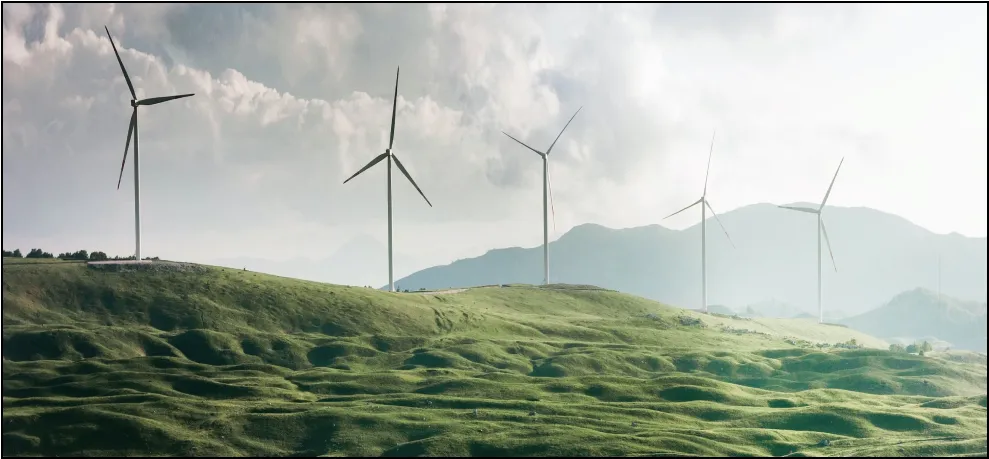
Harnesses the kinetic force of the wind, converting it into electrical energy using turbines. As a clean and renewable form of energy, it plays a significant role in reducing greenhouse gas emissions and is widely used on both land and sea.
-
The use of turbines placed on land to harness wind energy and produce electricity. These land-based turbines convert the kinetic force of the wind into electricity and work efficiently in regions with sufficient wind.
-
Harnesses wind energy via turbines placed in water, usually in the ocean, to produce electricity. Located away from the coast, these turbines take advantage of stronger and more stable offshore winds, resulting in greater energy production compared to land-based turbines.
-
A machine designed to convert wind movement into electrical energy. It consists of a rotor mounted on a tall structure that captures wind energy to turn a generator, which produces electricity. Wind turbines are the core of wind power generation and a sustainable, renewable option for producing electricity.
-
Also called hydroelectric power: the production of electricity from the energy of flowing water, usually from rivers or dams. Water flows through turbines and turns them, converting kinetic energy into electricity.
-
A large structure built across a river to hold water in a reservoir. The stored water is released through turbines, which generate electricity as it flows downstream. This is one of the most commonly used renewable energy sources, with substantial capacity for electricity production and benefits for water management.
-
An energy storage method that uses two reservoirs at different heights to store and generate electricity. During periods of lower energy demand, electricity is used to pump water from the lower to the upper reservoir. When energy demand is high, water is discharged back into the lower reservoir via turbines, generating electricity.
-
Uses the natural flow of rivers to generate hydroelectric power without significantly changing the course or water levels with large dams. Water is channeled through a turbine to generate electricity and then returned downstream, which minimizes ecological impact and maintains ecosystem balance.
-
Comes from the Earth's internal heat in the core. Through access to underground steam or hot water reservoirs, this energy can be converted into electricity or used for direct heating. Because it is consistently available, geothermal energy is an efficient and environmentally friendly option for electricity generation and heating.
-
Taps into the Earth's internal heat to produce electricity. The plant extracts steam or hot water from below the Earth's surface and converts this geothermal resource into electricity via turbines. This renewable energy source has low emissions and can provide consistent baseload power.
-
Describes the use of renewable marine resources, including wave, tidal and ocean thermal energy. It involves converting the dynamic forces of the ocean and thermal differences into electricity, which is an important source of clean energy that is particularly profitable for coastal areas.
-
Renewable energy generated by the natural rise and fall of ocean tides. Specialized systems convert the kinetic energy of the tides into electrical energy. Because tidal patterns are predictable and consistent, this source makes a dependable and substantial contribution to sustainable energy.
-
Renewable energy that comes from the movement of sea waves. Various devices and systems convert the kinetic and potential energy of waves into electricity or other useful forms. Wave energy is abundant and environmentally friendly, and it has significant potential, especially for coastal areas, where it can diversify the energy mix and help reduce carbon emissions.
-
Uses the temperature difference between the ocean's warmer surface and its colder depths to produce renewable energy. OTEC uses this natural temperature gradient to drive a heat engine that generates electricity. It provides a continuous, eco-friendly power supply, especially for tropical islands, where the difference in water temperature is greatest.