
AI software development company: private LLMs and AI inside your product
We build software around language models: AI features inside your product, and private models for teams that can't send their data to a public AI API. For PSONI, a Polish NGO, we self-host an open model instead of calling a provider's API, and its output is scored by a metric and reviewed by a person.
Tell us what you're building.
A few details help us put the right engineers in the first call instead of a salesperson with a slide deck.







AI is easy to demo, hard to ship
The model runs where your data is allowed to be
Private and on-premise LLMs
We host open language models ourselves, on infrastructure chosen for your rules, so texts never pass through a public AI API.
We pick the model by testing candidates on your real task, then serve it with vLLM and build the app around it.
Read more

Private LLM deployment for PSONI
For PSONI, the Polish Association for Persons with Intellectual Disability, we are building Generator ETR (ETR is the Polish abbreviation for easy-to-read). It is a web and mobile app that turns complex text, such as an official letter, into easy-to-read language, built in a two-year programme that started in 2026. The texts people paste in can be personal, so a public AI API was ruled out. The model is self-hosted on rented GPU servers and served with vLLM, so no text goes to an AI provider's API. Stored texts are encrypted and deleted under GDPR retention rules.
Before choosing the model we tested PLLuM 12B, a Polish-language model, on the same simplification task, and went with Gemma 4 in its 26B mixture-of-experts version. Around the model the stack is ordinary software your team can maintain: Django and Celery on the backend, React and React Native for the apps. If your rules require an on-premise LLM, the same setup can run on servers you control, provided they have suitable GPUs. Our glossary explains how self-hosted LLMs differ from API models.
Private LLM or public AI API: what changes
- Where the data goes. With a public API, every prompt and document leaves your infrastructure for the provider's servers. With a private LLM, texts stay on servers that you or your hosting provider control.
- Which model you run. With a public API you can pin a model version, but the provider retires old versions on its own schedule. A private deployment keeps the open model version you tested for as long as you need it.
- How you pay. An API is billed per token. A private model is billed for GPU time, whether it is busy or idle.
- What quality to expect. The largest API models are still stronger at general tasks, so a private model works best on a narrow task with its own evaluation, which is how we set up PSONI.
- Who keeps it running. Someone has to run the GPU servers, update the model and watch the output. We can take this on as part of support and maintenance.
Scored by a metric, reviewed by a person
LLM evaluation and guardrails
We score model output with an automated readability metric and with ratings from a reviewer trained in easy-to-read.
Jailbreak tests try to push the model off its task. We run them again on every new model iteration.
Read more

How we check that the output is good enough
On the PSONI project a script scores each simplified text with the Gunning Fog index, a readability measure, and writes a report over a set of test samples. That lets us compare one prompt or model version with the next, which is the core of LLM evaluation. A reviewer who works with the easy-to-read standard then rates real outputs against their source texts. The problem cases go into the next round of fixes to the prompt and the model, and we have been through several of those rounds.
Guardrails get the same treatment. Our QA tries to pull the model away from its job, for example by asking for an apple pie recipe instead of a simplified letter, and repeats those jailbreak tests on new iterations. When a text is legal or medical, the app shows a short notice: the simplified version is not a legal document, and a lawyer or doctor can explain the details. We are also testing a classifier that flags sensitive content such as hate speech or self-harm.
For readers with intellectual disabilities and for deaf users
AI for accessibility
We use AI to make content usable for people with intellectual disabilities and for deaf and hard-of-hearing users.
Simplified text, read-aloud, text from photos and live speech-to-text, inside apps built to WCAG 2.2.
Read more

Accessibility AI in two projects
In Generator ETR the simplification model is one part of the app. Users can take a photo of a letter and the phone reads the text on the device (Google ML Kit and Apple Vision), while PDF documents go through a separate pipeline on the server. A glossary explains difficult words in context. Text-to-speech reads the result aloud and highlights the fragment being read. We are now adding a normaliser that expands abbreviations and reads numbers and dates correctly in Polish before speech synthesis. The requirement for the whole app is WCAG 2.2 at level AAA.
Centrum Komunikacji runs a Polish Sign Language (PJM) interpreting platform that we build as part of a government accessibility programme. On it we added live speech-to-text for hard-of-hearing and late-deafened users. Automatic speech recognition writes a first draft in real time, a transcription specialist corrects it, and only the corrected text reaches the user as a chat message. The feature runs in production and handles personal data under GDPR.
AI features inside the product you already have
AI integration services
We add AI features to existing web and mobile products, usually as a separate service the application calls.
Examples: market news written from live data, an in-app AI chat and a product-search agent.
Read more
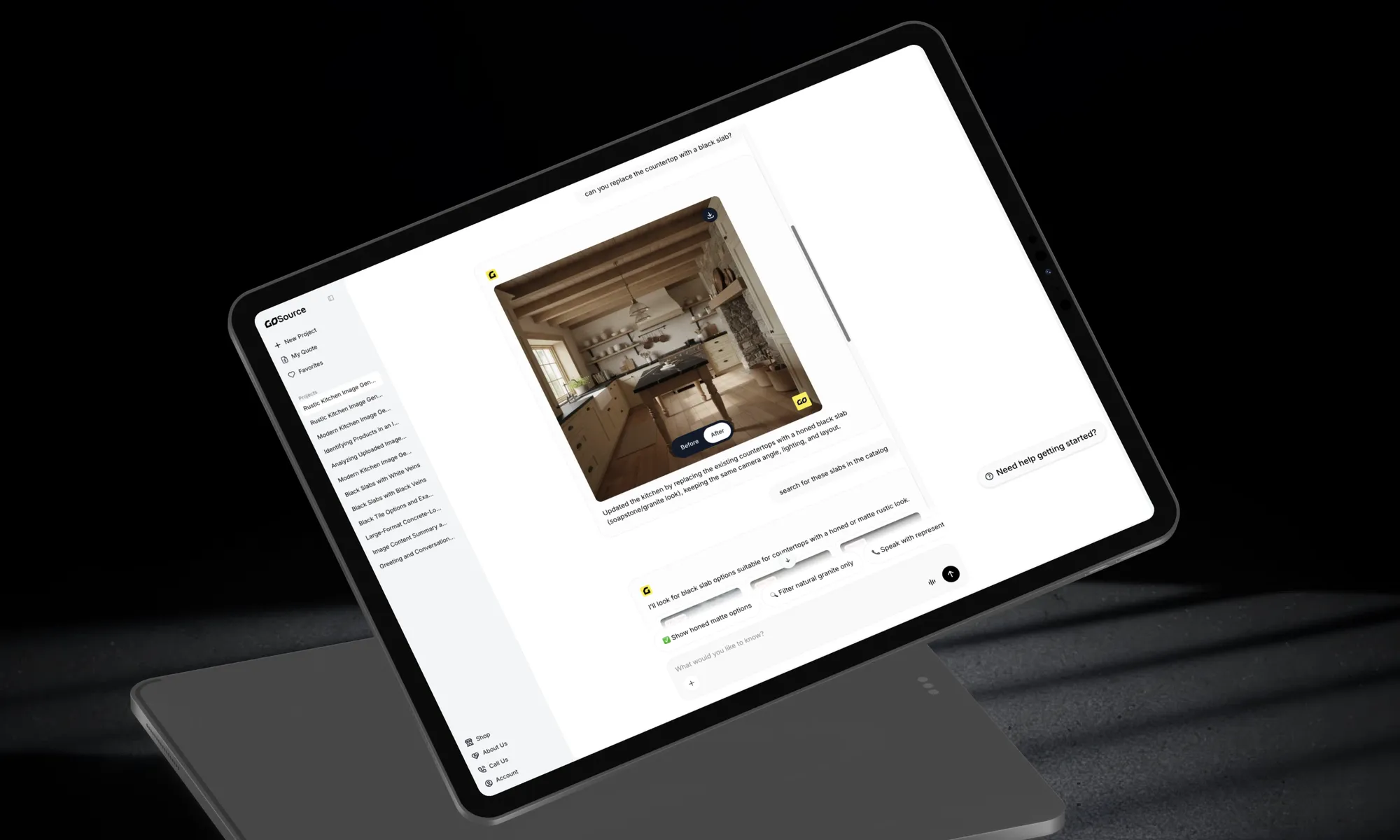
AI features in existing products
On the energy procurement advisory platform we built for Enerace, AI writes market news from current market data. The feature has been live since 2025.
For a product platform in the home renovation market we run an in-app AI chat and a product-search agent that works over product descriptions, metadata and prices from many suppliers. Both sit in a separate AI service that the main application calls. We usually keep that separation in AI integration services, because the AI part can then be measured, changed or switched off without touching the rest of the product.
From discovery to an AI MVP
Every project starts with a free discovery workshop. We look at your product, your data and the rules you work under, then agree what the AI should do and which test will show that it works. We have our own AI toolkit that we use in discovery. You leave with a scope and an estimate. Sometimes our advice is to skip the language model altogether.
Next comes a proof of concept on your real task, with the test samples and quality measures agreed before the first prompt. For AI MVP development we then add what real users need: the backend, accounts, the web and mobile apps. After launch we stay on for support and maintenance, because models, prompts and the data they read keep changing. Our article on AI proof of concept development covers the first stage in more detail.
Have a task where a language model could do real work, but data or accessibility rules make it hard? Start with a free discovery workshop.
Why organisations build AI with us
On PSONI the same team writes the prompts, evaluates the output and builds the interface to WCAG 2.2 at level AAA, so there is no hand-off between an AI vendor and a separate app agency. PSONI also owns the code of Generator ETR that we write.
AI articles from our blog
Read more


Do you have questions?
AI software development company - FAQ
-
Software in which a language model does a specific job for real users. That means self-hosted and on-premise LLM deployments, evaluation and guardrails for model output, and AI features added to existing products. In accessibility we build text simplification, read-aloud, text recognition from photos and live speech-to-text with human correction. We also build the web and mobile apps around the model.
-
Yes. For PSONI we self-host an open model (Gemma 4) on rented GPU servers, served with vLLM, so users' texts don't go to a public AI API. The same setup can run on-premise, on servers you control, or with a hosting provider in the region your rules require, as long as the servers have suitable GPUs.
-
It depends on the size of the model and how many requests it has to handle at once, because you pay for GPU servers rather than per request. We size the model and the servers during discovery, against your expected traffic, before you commit to a build.
-
No. Hosting the model yourself keeps texts away from a public AI provider, but GDPR also covers what you store, for how long and who can read it. On PSONI the stored texts are encrypted and deleted under GDPR retention rules, and we go through the same questions in discovery for any system that handles personal data.
-
With measures agreed at the start. On PSONI we combine an automated readability score with ratings from a reviewer who knows the easy-to-read standard, fix the problem cases and measure again. We also run jailbreak tests that try to push the model outside its task.
-
Not so far. In our projects the work has been choosing the right open model, writing and refining prompts, evaluating the output and serving the model, and that has been enough for the tasks we took on. If your task needs fine-tuning, we will tell you during discovery.
-
Yes. We usually add it as a separate service your application calls. On an energy procurement platform AI writes market news (live since 2025), and on a home renovation product platform we run an in-app AI chat and a product-search agent.
-
Yes. For PSONI we are building an app that simplifies text into easy-to-read language, reads it aloud and recognises text from photos. For Centrum Komunikacji we built live speech-to-text in which a transcription specialist corrects the AI draft before a deaf or hard-of-hearing user sees it.
-
A proof of concept answers one question: can a model do this task well enough on your data? An MVP puts that model in front of real users, with the backend, accounts and apps around it, and with the quality measures from the proof of concept still running.
-
With a free discovery workshop. We look at your product, your data and your constraints, and you get a scope and an estimate. Book a free AI discovery workshop and we will reply within 48 hours on working days.

AI software built for real users and strict data rules.
Your message goes to

Filip Szamborski
Co-founder & CEO

Your message goes to

Karol Oponowicz
Co-founder & Business Owner
Your message goes to

Paweł Zieliński
Co-founder & Business Owner
SO FAR WE HAVE WORKED WITH BRANDS LIKE:




Thank you for your message.
We read every message ourselves and get back to you within 48 hrs on business days.
Something urgent? hello@ordergroup.co